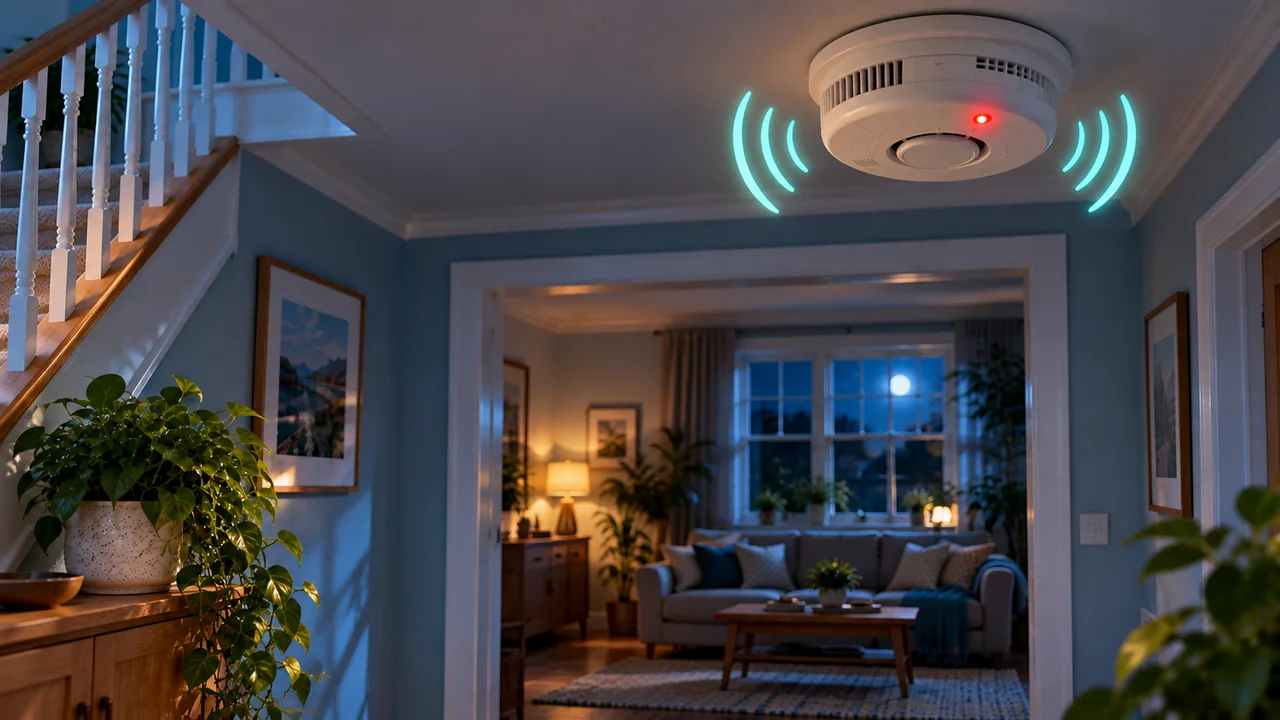
INTERACTIVE EIGHT-OPTION DIAGNOSIS
What happens at night?
Choose the closest signal and read the corresponding explanation below. For a full alarm or unclear danger, leave first.
QUICK ANSWER
Why does my smoke alarm go off at night?
A smoke alarm may seem to choose the middle of the night because a marginal battery can fail its low-power check as the temperature falls. But that explanation applies mainly to short, widely spaced maintenance chirps. A loud, repeated fire-alarm pattern at night is different: treat it as a possible fire, not a harmless temperature effect. Leave the property and follow its fire-escape procedure whenever fire cannot be confidently ruled out.
Night-time conditions can also expose moisture or condensation, persistent dust or an insect in the sensing chamber, loss of mains power, or a fault in an interconnected network. None of these is established merely by the time of day. The safest diagnosis starts with the sound, not the clock.
Kidde specifically explains why weak batteries can begin chirping during the coolest overnight hours; FireAngel also notes that temperature and condensation can be relevant to overnight nuisance signals.
For detailed low-battery and end-of-life signals, see why smoke alarms keep beeping. For a full warning with no obvious smoke, see why smoke alarms appear to go off without a reason. This page focuses on what overnight timing adds to those diagnoses.
SAFETY FIRST
A loud alarm at 3 a.m. is an emergency until proven otherwise
Do not assume an alarm is false because it happened at night, has sounded before, or stops by itself. Wake everyone, follow the escape procedure for your home and leave if the alarm is signalling fire or you are uncertain what is happening. Close doors behind you where safe and call the fire service from a safe location (UK 999/112; US 911). If you live in a block of flats, follow the building's established fire plan and emergency-service instructions.
For a single brief chirp every minute or so, with no full alarm or signs of danger, the issue may be maintenance-related. Identify the device and check its model instructions promptly. Do not remove its battery to sleep, cover the sensor, disconnect a mains alarm or disable interconnected protection. If the sound could be from a combined smoke and carbon monoxide alarm, use its exact voice/pattern indications; an unexplained CO warning is also an emergency.
FIRST DISTINCTION
A chirp at night is not the same as a full alarm
Listen for the pattern from a safe position, without staying in a building when a fire alarm is sounding. A chirp is commonly a brief sound with a substantial pause before the next one; a full alarm is loud, prolonged or repeated in a distinctive emergency pattern. Some alarms speak warnings or use several different sound patterns. Exact timings and LED colours vary by model; no single table can decode all devices.
| What you hear | What it might indicate | Safe first action |
|---|---|---|
| Short periodic chirp, mainly overnight | Low battery, end-of-life, or device fault | Check labelled model, battery and replacement date |
| Loud repeating alarm or voice warning | Smoke/fire warning, CO on combination models, or nuisance activation | Treat as an emergency; follow escape guidance |
| Several interconnected alarms together | One device has activated the network | Prioritise safety, then use the manual to identify origin |
A single chirp does not guarantee safety. Likewise, a blinking LED does not establish what sounded. If you cannot clearly identify the source and type of warning, do not guess.
NIGHT-ONLY CHIRPS
A weak battery crosses its warning threshold overnight
The battery in a smoke alarm must deliver enough electrical energy when the circuitry checks its condition. As a battery ages, its internal resistance can increase. Lower temperatures can make its performance worse, so a cell that just passes a check during the warmer daytime may fall below the warning threshold late at night.
That is why some alarms chirp around 2–6 a.m. and stop after the house warms. The chirping stops because the measured conditions changed—not because the battery repaired itself. Kidde describes this phenomenon directly. The exact time and sensitivity vary among homes and models. Room temperature alone is not a reliable way to diagnose an alarm.
What to do: if the alarm uses user-replaceable batteries, fit only the exact specified new battery type and retest as directed. If it has a sealed battery or has passed its replace-by date, the complete alarm may need replacement. If chirping continues, review the manual's fault codes and seek manufacturer support or replacement.
FULL ALARM
The full siren goes off while everyone is sleeping
This is fundamentally different from one short battery chirp. Smoke may be present outside your line of sight, in another room, around a faulty appliance or in a developing fire. Leave when there is a full alarm or genuine uncertainty. Never walk from room to room hunting a cause at the expense of safe escape.
After fire has been ruled out safely, recurring nuisance activations may involve particles in an optical chamber, steam or humidity near a bathroom, poor installation location, insects, dust or an ageing detector. The remedy depends on the manufacturer and installation: approved external cleaning, ventilation, correct siting or replacement. Do not spray cleaning products into a detector or reposition it to a less protective location simply for quiet nights.
The timing is a clue, not proof. A full alarm cannot be dismissed just because someone read that batteries chirp at night.
ALL ALARMS SOUND
Several interconnected alarms go off together at night
Linked alarms are deliberately designed to warn people in different rooms. A smoke detector that activates in a hallway, utility room or kitchen-adjacent area may cause alarms elsewhere to sound—even if the bedroom device is not the initiating unit.
Once it is safe and any emergency has been resolved, consult the specific manufacturer instructions to identify the initiating unit; some devices preserve a different flashing LED or alarm-memory state. Do not rely on a generic red-light pattern because brands differ. Aico and FireAngel offer model-specific explanations of interconnect and alarm-memory behaviour.
A one-off unexplained activation may warrant cleaning and inspection; repeated network alarms, unclear origin or problems with mains wiring require an installer or manufacturer support. Never disconnect linked alarms to stop the entire house sounding.
BEFORE DAWN
The alarm starts around dawn or when the heating cycles
If a warning reliably coincides with the overnight minimum temperature, note the indoor temperature and whether it is a chirp or full siren. A night-only chirp may correlate with battery condition. A nuisance full alarm might correlate with moisture or condensation around a sensor, but only after the alarm has been treated as a real warning and danger ruled out.
Steam from a nearby bathroom, overnight laundry moisture or warm air meeting a cooler ceiling can increase humidity. Some detectors can respond to condensation or airborne droplets. An insect or dust trapped in the sensing chamber may cause intermittent nuisance alarms independent of temperature. There is no reason to assume every 3 a.m. siren is a low battery.
During daylight, check the mounting environment against the manual: proximity to bathrooms, vents, draughts, window openings and cooking areas. Ask a qualified installer for compliant repositioning if the unit is incorrectly sited. A heat detector may be appropriate in a kitchen, but must never be substituted for required smoke coverage elsewhere.
MAINS & BACKUP
The chirp follows a night-time power interruption
Some hardwired alarms use a backup power source and may signal interruptions or a backup-battery issue. A breaker trip, brief supply interruption or work on another circuit can coincide with a warning, but the mechanism is model-specific. The absence of a green power indicator has different meanings among products.
Without touching wiring or opening a mains alarm base, observe any obvious general power failure and read the alarm's status indications using the manual. If power appears lost to a hardwired alarm, or if a protective device repeatedly trips, arrange a competent electrician or landlord-maintenance visit. Do not repeatedly reset breakers or remove detectors from live bases.
A short chirp as the alarm changes power state is not equivalent to a full smoke or CO alarm. If any loud emergency pattern is heard, follow the safety-first guidance instead.
BATTERY CHANGED
The alarm still chirps after fitting a new battery
First confirm the type of alarm. User-replaceable batteries and sealed-for-life products require different actions. For a replaceable model, verify the cell is new, approved for the device, installed with the correct polarity and that the drawer or cover is properly closed. Check the alarm age and use its specified test sequence. Not all alarms use the same button timing, reset or memory-clearing procedure.
An old unit can announce end-of-life independently of battery condition. Likewise, a fault signal can continue after a battery swap because the battery was not the underlying problem. Replacing a battery does not override a defective sensor or expired alarm.
If the alert persists after the approved checks, replace the detector or request servicing. Do not bridge its contacts, bypass the alarm or silence it indefinitely so you can sleep.
WHICH DEVICE?
You hear a sound at night but cannot tell which detector it is
A short chirp can reflect around hallways and stairwells, making direction difficult to judge. After ensuring this is not an active emergency alarm, note the time, approximate interval, LED behaviour and location of every nearby smoke, heat and carbon monoxide alarm. Check each labelled device and its replacement date by daylight.
Sometimes a carbon monoxide alarm, security keypad, sensor, UPS, appliance or inaccessible neighbouring device makes a similar sound. Never assume the source is a smoke alarm merely because the chirp is near the ceiling.
Do not remove several alarms at once for a guessing exercise. A consistent log of which devices show fault indications, combined with manufacturer guidance, is safer than disabling protection. If a CO alarm may be sounding its emergency signal, evacuate to fresh air and seek emergency assistance.
SEALED & SMART
The unit is sealed, smart or reports an unusual night warning
A 10-year sealed battery is not a promise that every unit will last ten full years from the date you bought it; check the actual replacement label. When a sealed device reaches its prescribed end of life or cannot pass its test, replace the complete device. Some models intentionally use ambient light to defer maintenance chirps overnight, but that feature is not universal. Kidde documents this for certain connected models, and their other models may behave differently.
A smart app alert or offline notification does not on its own identify a smoke alarm's acoustic signal. Check the device's own indicator and manual. Keep the local sounder, backup power and interconnection functioning even when Wi-Fi is unavailable; if those protections fail, arrange replacement or service.
For an in-warranty alarm that repeatedly behaves abnormally, keep the model and manufacture details ready for the manufacturer's support team. Do not modify a sealed unit.
DAYLIGHT CHECKLIST
How to prevent another unexplained night alarm
After the household is safe, use this straightforward daylight checklist:
- Record the exact sound: spaced maintenance chirp versus full siren or voice alert; note whether it repeats only at night.
- Find the source: read the make and model on the specific smoke/heat/CO unit, rather than assuming the nearest device chirped.
- Check battery and age: use only approved replaceable batteries; replace sealed or expired units as directed.
- Test as the manual specifies: the test button should produce the expected sound, and linked units should respond where required.
- Check the environment: inspect for cooking fumes, steam, dust, insects, condensation or siting too close to vents or bathrooms.
- Escalate: repeated full alarms, unresolved fault indications or mains/interconnect problems should be addressed by the manufacturer or a competent installer.
Do not use improvised flames or smoke to test the alarm, leave alarms unpowered overnight, or apply a generic online reset sequence that does not match the model.
MECHANISM DIAGRAMS
Why night timing can change what you hear
The first illustration shows one possible mechanism for night-only maintenance chirps. The second separates the immediate fire-safety response from later troubleshooting. These diagrams are educational and do not replace your detector's printed sound code.


UK & US GUIDANCE
Regional differences, mixed systems and alarms near bedrooms
In the UK, manufacturers including FireAngel, Aico and Kidde publish model-specific maintenance and test sequences; landlords and residents should follow the applicable rules for their property. The UK fire service may advise a heat alarm in a kitchen where smoke or steam is common. In the US, Kidde and First Alert alarms may use different sound and indicator codes, with recommendations from the US Fire Administration and local codes.
Where you live, do not assume that three beeps, a red LED or a night-time chirp has a universal meaning. Read the exact model number and user guide. CO-only and combination smoke/CO alarms deserve special attention because their emergency response differs from ordinary smoke-alarm maintenance.
Protecting sleeping occupants matters most. Maintain the required alarms in bedrooms, near sleeping areas and across the home according to local regulations and the installation design. Do not relocate a nuisance device without an appropriate replacement plan.
FREQUENTLY ASKED QUESTIONS
Smoke alarms sounding at night: FAQs
Why does my smoke alarm chirp at about 3 a.m.?
A weak battery may supply less power as the room cools, causing a low-battery chirp during the coldest hours. Confirm the pattern and follow the exact model instructions.
If the chirping stops in the morning, is it fixed?
No. Warming can temporarily change battery performance without restoring the battery or repairing the device. Check it promptly.
Can a smoke alarm sound a full siren because the battery is cold?
A low-battery chirp is not the same as a full fire-alarm warning. Treat a full alarm as possible fire regardless of the time.
Why do all my smoke alarms go off together at night?
Interconnected devices may all sound when just one detects a warning. Treat the warning as real, then use model-specific memory indications once safe.
Can overnight condensation set off a smoke alarm?
Moisture or condensation may cause nuisance activation in some sensor designs. This is a possible cause only after real danger has been excluded.
What if a sealed ten-year alarm chirps at night?
Check its status and replace-by label. Do not open a sealed battery compartment; replacement of the whole alarm may be necessary.
Why is my hardwired alarm chirping although the mains power is on?
Backup-battery, age, fault or model-specific status may still be responsible. Do not open a live base or assume a lit power LED certifies it as safe.
Should I disconnect the smoke alarm so I can sleep?
No. Never disable required fire protection to stop a warning. Replace or service the device promptly.
Can I use Hush or Silence overnight?
Only if the manual permits it and the cause has safely been established; Hush is temporary and never a substitute for solving a fault.
Why is it hard to locate a one-minute chirp?
Short high-pitched sounds can reflect off walls and ceilings. Check each alarm and its status rather than removing devices randomly.
Could my carbon monoxide alarm be making the night-time sound?
Yes. Identify the exact device and sound. A CO emergency alarm requires immediate evacuation to fresh air and emergency help.
What should I do if the alarm keeps going off after cleaning and battery changes?
Check the replacement date and contact the manufacturer or a qualified installer; repeated unexplained alarms may require replacement or professional inspection.
AUTHORITATIVE SOURCES
Manufacturer and fire-safety references
Model and serial-number details take priority over general beep-code charts. These resources were reviewed for this night-timing guide:
- Kidde — why smoke alarms chirp in the middle of the night
- Kidde — consistent chirping and warning conditions
- Kidde — why an alarm sounds, beeps or chirps
- FireAngel — nuisance alarms and why alarms beep
- FireAngel — alarm code and battery replacement advice
- FireAngel — FAQs and linked alarm information
- US Fire Administration — installing and maintaining smoke alarms
- London Fire Brigade — household fire escape advice
- GOV.UK — fire safety in the home
- Electrical Safety First — take chirping alarms seriously