INTERACTIVE EIGHT-OPTION DIAGNOSIS
What is the red light doing?
Choose the closest pattern. This finder gives context, not a safety clearance or a universal beep code. If the alarm is sounding or fire may be present, leave first.
QUICK ANSWER
Why does a smoke alarm flash red?
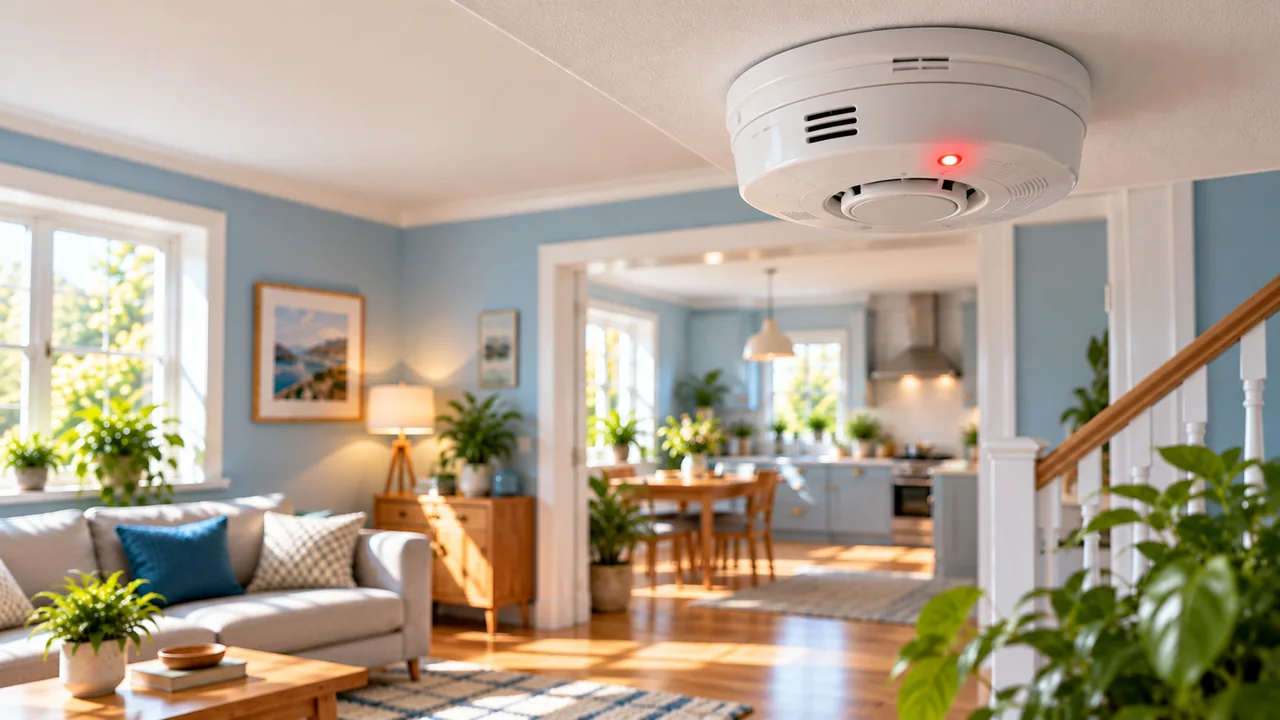
A flashing red smoke-alarm light often indicates that the alarm has power and is monitoring normally, but its meaning depends on the exact model. Rapid flashes with a loud alarm, periodic groups of flashes, and a single quiet blink can indicate very different conditions.
For example, a FireAngel FA6620-R may flash red about every 40 seconds in ordinary standby. Some UK Kidde models flash red much less frequently, while others use clusters of flashes to record a previous activation. Some First Alert devices use a green standby light and a red alarm light. A single timing rule would therefore be misleading.
Rather than guessing from colour alone, note (1) the make and model, (2) the pattern and interval, and (3) whether there is chirping, a full alarm, or a recent activation. The diagnostic finder below helps you decide which explanation and safe next step to read.
FIRE SAFETY FIRST
When a red light means stop troubleshooting
If the smoke alarm is sounding a loud repeating fire-alarm pattern, if you see or smell smoke, or if you cannot establish that the building is safe, alert others and follow the fire escape plan immediately. Call emergency services from a safe place outside (999/112 in the UK, 911 in the US). Never ignore an audible alarm because you think the light is behaving normally.
An interconnected network can make every alarm sound even when smoke reaches only one detector. Do not remain in a potentially unsafe building trying to discover which unit started it. In flats and managed buildings, follow the established fire strategy and emergency services' instructions.
NORMAL STANDBY
One quiet red flash every 30–60 seconds
On many battery-powered alarms, the electronic controller periodically flashes an indicator while it checks its circuitry and monitors for smoke. There may be no audible sound because this is a status indication rather than a warning. For example, the FireAngel FA6620-R lists a red flash about every 40 seconds as normal operation.
However, the interval is not universal: Kidde's UK KF10/KF20 manual lists a red flash once every five minutes and 20 seconds for certain models. A US First Alert model may blink green in normal operation. Check the exact model instructions rather than treating an online "every 40 seconds means OK" claim as universal.
If the unit has been installed correctly, is in date, has no chirps or other fault signs, and passes its specified test procedure, an occasional quiet blink may be expected. A visible flash is not itself a complete functional test.
ACTIVE ALARM
Rapid red flashing or a red light with loud beeps
During an active fire-alarm event, many models flash an LED rapidly in time with a loud sounder. Some units use repeated sets of three horn blasts followed by a pause, while others have model-specific patterns. Treat a loud alarm as a real hazard first: leave and seek help when needed.
If everyone is safe and a false activation is confirmed, use the manufacturer's instructions to identify the initiating device and the proper Hush procedure. Cooking aerosols, steam or dust may cause nuisance activations in some smoke sensors, but they cannot be assumed to be the cause before checking safety. Repeated nuisance alarms need a siting or equipment assessment, not permanent disabling.
If the loud alarm belongs to a combination smoke and carbon monoxide device, its sounds and visual signals can indicate different hazards; consult the device markings and the manual only from a safe situation.
ALARM MEMORY
Several red flashes after the alarm has stopped
Some interconnected or hardwired smoke alarms preserve evidence of the alarm that first detected a problem. A cluster of rapid red flashes at regular intervals can be an alarm-memory signal rather than continuing smoke detection. The UK Kidde KF10/KF20 guide, for instance, documents three rapid red flashes at 40-second intervals after an alarm event.
Other models use different patterns, colours, or a stored event in an app or control panel. Kidde also describes models whose initiating unit flashes at a different rate for a period after an interconnected event. Never assume that three flashes always mean the same thing across brands.
After the property is confirmed safe, write down the indicator sequence and the model number. Compare it with the manufacturer's alarm-memory section to identify what happened and whether the sensor or its location needs attention.
HUSH OR SILENCE
Red light after pressing Hush or Silence
Some alarms blink a different pattern while a temporary Hush mode is active. Hush usually lasts a limited number of minutes and is intended for a known non-emergency cause, such as harmless cooking aerosols, after a danger check. The UK Kidde KF10/KF20 manual lists a red flash approximately every 10 seconds in Hush mode for certain models.
Silencing a sounder does not mean all hazards are gone. A continued or renewed fire-alarm warning requires emergency action. If the light remains unusual after the stated Hush period, consult the manual, verify the replace-by date, and contact the manufacturer rather than repeatedly pressing buttons.
CHIRPS AND FAULTS
Red flashing accompanied by periodic chirping
A short, isolated chirp every half-minute or minute is often a maintenance notification, not the same as a full fire-alarm sound. Depending on the manufacturer, it may indicate a depleted replaceable battery, a sealed-battery end-of-life state, contamination, an internal fault, or a mains/backup supply issue.
Some FireAngel models combine red flashes and chirps, with different flash counts for low battery and malfunction; the pattern differs by model. Check the printed replace-by date, battery type and specific indicator chart. Do not replace sealed-for-life batteries by opening the alarm. If the unit is end-of-life or cannot pass its prescribed test, replace it promptly.
For a hardwired alarm, a power-status light may be independent of its red warning light. Never open a mains-powered unit or inspect its wiring yourself. Contact a competent installer if power is missing or a fault persists.
MAINS-POWERED SYSTEMS
Why a hardwired alarm may show red and green lights
Mains-powered smoke alarms often have a separate power indicator and event/status indicator. On some Kidde models, steady green means AC mains supply is present while red communicates alarm, memory or Hush status. On others, the standby behaviour differs. Do not assume a red LED means mains power has failed.
If an interconnected hardwired alarm sounds, the unit showing an unusual or rapid red flash may be the initiator, but that depends on the system. Some connected units can sound without showing the same red pattern as the initiating alarm. Follow the manufacturer's wiring/system guide.
Where the power indicator is absent, or several devices behave inconsistently after an outage, use non-invasive observations only. Do not remove the ceiling base, disconnect interconnect conductors, or work inside a live junction box.
NO LIGHT OR UNUSUAL COLOUR
What if the red LED stops flashing?
Not every smoke alarm is designed to flash red in standby. Some blink green, some suppress visible flashes in dark conditions, and some use an app or separate LED status. Therefore, the absence of a red blink does not automatically mean failure.
Nevertheless, if the manual specifies a regular indicator and that indicator is missing, check the manufacture/replace-by date and follow the approved button-test method. For models with replaceable batteries, use only the battery specified by the manufacturer. If a sealed-battery alarm fails its self-test or is expired, replace the unit. For mains-powered alarms, seek qualified help when the power/status indication is abnormal.
Never test using smoke from a match, a candle or a flame. Such methods can cause a fire or damage the sensor.
COMBINATION DETECTORS
Smoke and CO combination alarm red lights
Combination smoke/carbon-monoxide alarms may use one LED for several operating states, or have separate indicators and voice messages. A red flash on a combined alarm might mean a smoke event, CO event, alarm memory or self-test depending on its model. The audible warning pattern is often the most important distinction, but again varies.
If a CO warning might be active, get everyone outside into fresh air and contact local emergency services. Do not return until given the all-clear. Use the product manual later to decode the status; do not rely on generic online colour charts.
TWO VISUAL EXPLANATIONS
How red indicators encode status and alarm history
The diagrams below illustrate a decision process, not universal LED timing codes. Exact flash counts and intervals must always be taken from the manufacturer manual for the installed model.


SAFE CHECKLIST
How to identify what your smoke alarm is telling you
- Deal with any active hazard first: if the sounder is alarming or smoke is suspected, evacuate and call emergency services from outside.
- Identify the actual device: smoke, heat, CO or combination. Check the visible label or accessible documentation; avoid removing a hardwired unit.
- Find the make and exact model: note the manufacturer, reference number and, where visible without dismantling, the replace-by date.
- Observe the pattern: single flash or cluster; approximately how often; silent or with a short chirp; immediately after a real alarm or Test/Hush button press.
- Match the manual: use the model's own chart for standby, alarm memory, hush, low battery, fault and end-of-life indications.
- Use the approved test: press the manufacturer's Test button at the recommended interval, away from your ears. If the test fails, replace or arrange professional assessment.
- Address maintenance signals promptly: replace specified removable batteries when appropriate, clean only as instructed, or replace expired/sealed alarms.
- Keep connected systems working: if several alarms activate, consult the initiating-alarm instructions after the property is safe; seek installer help rather than altering wiring or interconnection.
UK AND US DIFFERENCES
How manufacturer signals differ by region
UK: FireAngel and Aico supply widely used domestic smoke alarms. Many FireAngel models use a periodic red standby flash; some Aico mains-powered alarms show green AC power separately from red alarm indication. Manufacturer manuals and installed-model suffixes are essential, particularly for interconnected systems. For a potential fire, call 999/112 from safety.
US: Kidde and First Alert/BRK models may use different standby colours, audible patterns and alarm-memory indications. One First Alert SM210 manual, for example, uses a green power flash in normal operation and red when smoke is detected or after silencing. USFA advises testing in accordance with manufacturer instructions and replacing alarms at the stated service life; many domestic smoke alarms require replacement at about ten years. For a fire emergency call 911.
Do not infer country, power source or failure status from red alone. Manufacturers may change indicators between generations even when product names are similar.
COMMON QUESTIONS
Smoke-alarm red-light FAQs
Is a smoke detector supposed to blink red?
Many models blink red during normal standby, but others blink green or use a different schedule. Confirm with the installed model manual and test as instructed.
What does one red flash every 40 seconds mean?
For several FireAngel models this is normal operation. Other makes and models use different patterns; do not treat the interval as universal.
Why is my smoke alarm flashing red every ten seconds?
Some models flash differently in Hush mode or alarm memory. Check for any active warning and consult the exact device manual.
Why does the red light flash three times?
Some Kidde alarms show three rapid flashes at intervals to identify a past activation. Other products use multiple flashes for faults or different states.
Why does it blink rapidly with loud beeping?
This may be a current smoke or fire alarm. Evacuate and contact emergency services if fire is possible or the cause is unknown.
Does a red light mean the battery is low?
Not necessarily. Low battery is usually indicated by a model-specific chirp/LED sequence; red can also mean normal standby, alarm or memory.
What does flashing red after silencing an alarm mean?
Depending on the device, it may indicate Hush mode or a stored alarm event. Hush is temporary and should only be used for a verified non-emergency.
Why is it flashing red but making no sound?
A silent flash often indicates ordinary standby or alarm memory. Check the count, interval and manual instead of drawing conclusions from the colour alone.
Why is it still flashing after changing the battery?
The flash may be a normal power-status indication. If a fault chirp continues, check correct battery installation, replace-by date and model instructions.
Should the smoke alarm have a green and a red light?
Some mains-powered models use green for AC supply and red for alarm status, while other products use different colour conventions.
Is a flashing red light a substitute for testing the alarm?
No. Status LEDs cannot establish complete operation. Use the manufacturer-approved Test button and replace a device that fails.
Can I disable the red light?
Do not modify or cover the alarm. Some approved models automatically reduce light in darkness; use only documented manufacturer features.
OFFICIAL REFERENCES
Manufacturer manuals and fire-safety sources
Use these sources to find your exact model’s indicator and test instructions; the examples in this article are not a universal flash-code chart.
- FireAngel FA6620-R — normal red LED flash
- FireAngel — signals for chirps and faults
- Kidde — red LED and smoke-alarm self-testing
- Kidde — finding the initiating alarm and memory signals
- Kidde UK KF10/KF20 smoke alarm manual (PDF)
- First Alert/BRK SM210 manufacturer manual (PDF)
- Aico — smoke and heat alarm fault finding
- US Fire Administration — smoke-alarm care
- FireAngel — smoke-alarm product FAQs