INTERACTIVE EIGHT-OPTION DIAGNOSIS
What kind of carbon monoxide alarm sound do you hear?
Choose the closest pattern for an explanation. This interactive tool cannot determine whether an indoor space is safe. Any loud repeating CO alarm, unidentified alarm or possible exposure means leave first, then call for help from outside.
QUICK ANSWER
Why does a carbon monoxide detector beep?
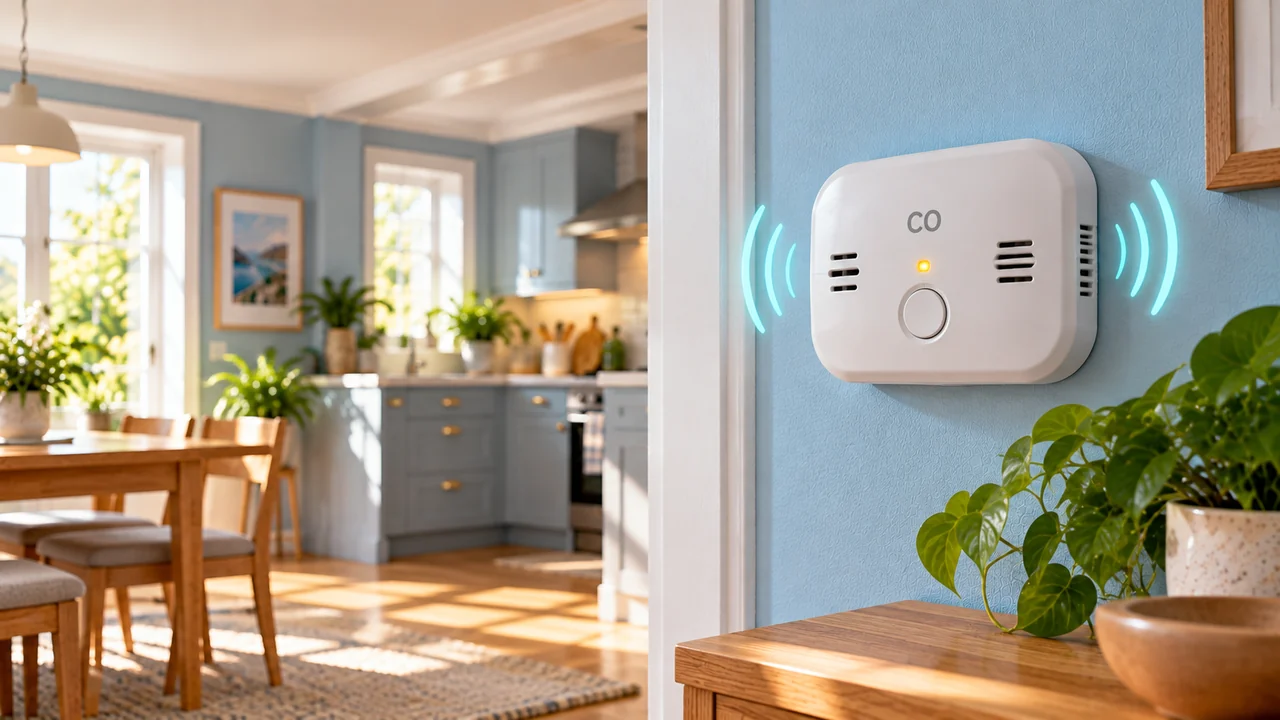
A CO detector beeps either because it may have detected dangerous carbon monoxide, or because its own power, sensor or electronics need attention. A loud repeating alarm requires immediate evacuation and emergency advice. A lone maintenance chirp every 30–60 seconds often suggests a low battery on certain models, but other patterns can indicate sensor failure or the end of the alarm’s usable life.
Carbon monoxide is invisible and has no smell. It can come from faulty or poorly ventilated gas, oil, coal or wood-burning equipment, blocked flues, generators and vehicle exhausts. A CO alarm is a safety warning, not a gas-leak detector or a complete inspection of your appliance.
The right question is not only “How do I stop the beeping?” but “Is this an exposure warning or a device-maintenance warning?” Always establish safety before checking the alarm label, light codes, age and power source.
SAFETY FIRST
What to do when the CO alarm sounds loudly
- Move everyone outside immediately into fresh air, including children and pets. Do not stay inside to search for the problem or count beeps.
- Call for assistance from outside. In Great Britain, report suspected gas-related CO to the National Gas Emergency Service on 0800 111 999; call 999 or 112 for a medical emergency. In the US, call 911 and follow the local fire department’s instructions.
- Tell responders about symptoms. Headache, dizziness, nausea, weakness, confusion or multiple people feeling unwell together may indicate exposure. Seek urgent medical assessment even if symptoms improve outdoors.
- Do not re-enter until the appropriate emergency service or qualified professional explicitly confirms safety. Do not silence/reset the alarm to justify resuming normal use.
If stopping an appliance would delay evacuation, leave it running and get outside. Even when an alarm has stopped, an underlying CO problem may remain. The absence of a visible flame problem or smell means nothing: CO itself is odourless.
MECHANISM FIRST
How a CO alarm detects gas — and why maintenance chirps are different
Many home CO alarms use an electrochemical sensor. Carbon monoxide reaching the sensing material produces an electrical signal; the unit evaluates the level and duration of exposure according to its specification, then triggers its warning. It does not need visible smoke or a burning smell.
Separately, the alarm monitors conditions such as battery voltage, internal electronics, sensor life and—in certain wired models—backup power. A maintenance beep comes from this self-monitoring path rather than the same emergency detection sequence. A failed or expired sensor may no longer provide reliable CO protection.

That is why replacing a battery cannot repair an expired sensor and why an alarm pattern should never be treated as a routine low-battery warning simply because the unit is old.
SOUND PATTERNS
Four beeps, single chirp or three quick beeps?
Some well-known devices use four beeps and a pause for a CO alarm. Other models use a spoken message, a display or different sequences. Specific FireAngel models use one beep for low battery, two for a fault and three for end of life, while models from other manufacturers may differ. There is no universal colour-and-beep translation.

A practical identification sequence is: first respond to a repeating alarm as an emergency; later, in a safe setting, note the manufacturer/model, displayed code, chirp interval, indicator colour and replacement date, then use the manufacturer’s instructions to interpret them.
One short chirp every minute: possible low battery
On some replaceable-battery models, a single periodic chirp indicates the battery is too weak to guarantee full-volume alarm operation. The electronic circuit can still produce a little sound while no longer having adequate reserve to protect you.
Only after confidently identifying the sound as a maintenance notification—not an active CO alarm—check the approved battery type and follow the printed instructions. Fit the correct fresh battery, check polarity and latch the compartment properly. Test as the manufacturer directs. Do not remove a battery and leave the room unprotected.
Some detectors have non-replaceable batteries or a combined sensor/battery end-of-life signal. If the pattern differs, the safe next step is the exact model manual, not a guessed battery replacement.
Why is it still beeping after changing the battery?
A fresh battery does not automatically clear an end-of-life timer, sensor fault or loose battery-compartment connection. The replacement battery might also be the wrong chemistry or installed incorrectly for that device.
Read the label and identify the warning code, confirm approved battery type and fitting, and perform the manufacturer’s specified test or reset only for a known maintenance fault. If the unit continues to report an error or expired service life, replace the alarm rather than repeatedly silencing it. Do not dismantle the sensing chamber or use unapproved reset sequences from unrelated brands.
Sealed-battery CO alarms: replace the complete detector when required
Some CO alarms are designed with a sealed long-life battery. Their maintenance beep does not imply a removable cell is hidden inside. Cutting open or modifying a sealed unit may destroy its protection and create a battery hazard.
Look for its “replace by” date and model-specific error pattern. When the unit indicates end of life or fails its self-check, fit a suitable replacement without leaving a gap in coverage. Product service lives vary: do not assume every CO alarm lasts exactly ten years.
Two or three quick chirps: fault or end-of-life alert?
Some FireAngel devices distinguish faults from end of life using two or three rapid chirps with matching yellow flashes, but this is not an industry-wide rule. Other manufacturers may use a different interval, voice announcement or display text such as END, EOL or ERR.
If the manufacturer says the sensor has expired, replace the entire alarm immediately. If a fault code suggests the unit cannot sense CO reliably, do not continue relying on it while investigating; replace it or follow the manufacturer’s safe support process.
What do FAULT, ERR and warning LEDs mean?
A status light on its own is not enough to diagnose most CO detectors. Colours and flash timings can reverse between models; some units flash periodically during normal operation, while others show memory of a previous alarm.
Look up the exact code rather than applying a generic internet chart. Fault conditions can reflect a failed self-test, depleted backup source, damaged sensor or electronic error. A detector that will not pass its prescribed test should be replaced. A test button normally checks the alarm circuit; it does not certify that the CO sensor remains chemically accurate.
Hardwired, mains-powered or plug-in carbon monoxide alarms
A mains-powered alarm may have a battery backup. It can still chirp because of a depleted backup battery or missing incoming power; other beeping patterns may indicate an internal fault or end of life.
Observe the normal power indicator and whether nearby sockets have power. If there has been an outage, consult the manufacturer's guide once safety is established. Do not open the detector’s mains connector, remove a wired cover or modify electrical connections. If power or wiring needs testing, use a qualified electrician or installer.
I cannot tell which alarm is beeping
Smoke alarms, heat alarms, CO alarms and combination devices can share a building and may be interconnected. A sound may seem to come from the hallway even though the initiating alarm is in another room, and some combined detectors use different patterns for smoke and CO.
For a loud repeating or unidentified alarm, evacuate rather than walk room to room to identify it. Only when responders have confirmed the property is safe should you check manufacturer labels, alarm history or the initiating-unit indicator and restore proper protection.
SAFE MAINTENANCE ONLY
A checklist for a confirmed maintenance chirp
- Confirm that the sound is not a full CO warning and nobody has symptoms of exposure.
- Identify the alarm brand and model from an accessible label or paperwork.
- Compare the chirp, LEDs and display code with that model's instructions.
- Check the replace-by date and whether the battery is sealed or replaceable.
- If the manufacturer allows battery replacement, use the approved type and test it as directed.
- If fault or end-of-life warnings remain, replace the detector and verify coverage; do not bypass the warning.
CO detectors are not substitutes for combustion-appliance servicing, flue inspections or ventilation. In rented accommodation, report an unsafe or defective alarm to the landlord promptly, without delaying any emergency response.
UK & US GUIDANCE
UK and US emergency and equipment differences
Great Britain: For a suspected gas-related CO incident, call the National Gas Emergency Service on 0800 111 999 once outside; use 999 or 112 for a medical or fire emergency. Only a competent professional should inspect or repair fuel-burning equipment.
United States: For an active CO alarm or suspected poisoning, evacuate and call 911 from outside. Follow local fire department instructions before returning. US listings and device guidance often reference UL standards, whereas UK domestic CO products commonly reference BS EN 50291; always follow local requirements and the specific device manual.
For both countries, a single detector should not be treated as a home-wide guarantee of safety. Follow local rules for alarm location, coverage, testing and replacement. Never bring a generator, barbecue or vehicle exhaust source into an enclosed occupied space.
FREQUENTLY ASKED QUESTIONS
Carbon monoxide alarm beeping: frequently asked questions
Does four beeps always mean carbon monoxide?
Many Kidde and FireAngel models use a four-beep repeating CO alarm sequence, but not every product has identical sound codes. Treat a loud or unknown repeating alarm as a CO emergency and evacuate.
Can a carbon monoxide alarm beep when there is no CO?
Yes. It may produce a maintenance warning for low battery, self-test failure or end of sensor life. You should never assume a loud alarm is a false positive without professional assessment.
Why does my CO alarm chirp once every minute?
For some devices that is a low-battery warning. Other models use similar chirps for faults or replacement alerts. Check the exact model's manual and LED/display pattern.
Will a new battery fix an expired CO detector?
No. Sensor expiration is independent of a removable battery. Replace a detector that has reached its documented service-life limit.
What does END or EOL mean on the alarm?
Often it means end of life, but confirm the code in your manufacturer’s manual. An expired sensor needs replacement, not repeated resetting.
Can I unplug a CO alarm to stop the sound?
Never disconnect an active CO warning to continue using the space. Evacuate first and follow emergency advice; a safely confirmed faulty detector must be replaced promptly.
Why is it beeping after I replaced the battery?
Possible causes include incorrect battery type or fitting, another maintenance code, internal fault or an expired sensor. Use the device-specific instructions.
Do hardwired CO alarms have batteries?
Many do have backup batteries, but designs vary. Check the product specification and do not open mains wiring.
How many years does a carbon monoxide alarm last?
Service life varies by product and certification. Follow the replace-by date printed on your particular unit, rather than assuming every model lasts seven or ten years.
Can a CO detector detect a natural gas leak?
No. A CO alarm is designed for carbon monoxide from combustion, not for methane or propane. Those gases require appropriate different detectors and emergency advice.
What if the alarm stopped by itself?
That does not prove the air is safe. If it was an emergency CO alarm, do not re-enter until responders or a qualified professional have cleared the property.
Will the test button prove the sensor is detecting CO?
Usually not. The button checks parts of the alarm's electrical and sound circuits. It does not verify the chemical accuracy of the CO sensing element; follow the product's maintenance and replacement schedule.
AUTHORITATIVE REFERENCES
Manufacturer and public-safety sources
Consult your exact model manual for sound and LED codes, and use official safety guidance for emergency responses.
- GOV.UK — Carbon monoxide exposure and emergency response
- NHS — Symptoms and treatment of CO poisoning
- FireAngel — Why a CO alarm beeps
- Aico — Alarm fault-finding guidance
- Kidde — CO beeping and chirping patterns
- US CPSC — Carbon monoxide safety fact sheet
- Kidde — CO alarm replacement and end-of-life warnings
- London Fire Brigade — Carbon monoxide safety