EIGHT-OPTION INTERACTIVE SYMPTOM FINDER
What is actually staying on?
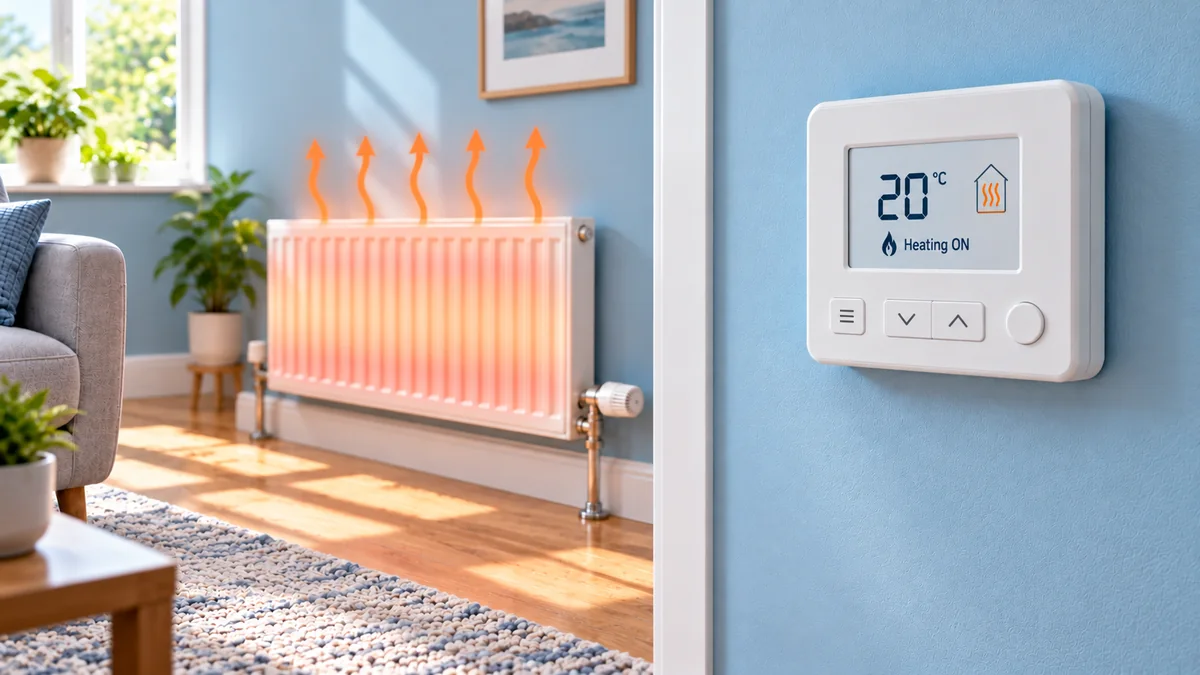
Before blaming the thermostat, identify what is still running: a call-for-heat indicator, the boiler burner, a circulation pump, warm radiators or a US furnace fan. Choose the closest observation and follow a targeted, safe next step.
QUICK ANSWER
Why does my heating stay on?
Heating may stay on because a thermostat, schedule, Boost or another zone is still requesting heat; because a relay, receiver, motorised zone valve or diverter valve does not release correctly; or because you are seeing normal residual warmth, pump overrun, frost protection or a furnace fan after active heating has stopped. A heat pump may also operate for long periods by design.
The key is to distinguish a system that is still making heat from one that is merely circulating or releasing heat already produced. A warm radiator does not prove the boiler burner is on. A fan sound does not prove a gas furnace is burning fuel. And “Off” can mean different things on a room thermostat, programmer and boiler display.
SAFETY FIRST
When continuous heating is urgent
If rooms are severely overheating and normal controls cannot stop active heating, contact the installer or an appropriately qualified heating engineer promptly. Follow your appliance manual for its dedicated user-accessible shutdown or isolation control if safe; do not remove boiler covers, open electrical receiver boxes, touch a live motorised valve, bridge thermostat terminals, interfere with gas valves or defeat frost/safety protection. Turning off all heating power for long periods in freezing weather may leave pipework unprotected.
THE FIRST TEN MINUTES
Seven checks before assuming something has failed
- Confirm the room temperature and target. Is the displayed measured temperature actually above the selected target? A thermostat may tolerate a small temperature band before changing state. Avoid comparing a thermostat with a thermometer next to a hot radiator or in direct sun.
- Inspect the current heating mode. Check Schedule, Manual, Continuous, Hold, Boost, Away and Holiday settings. A programmed change, voice-assistant routine or smart radiator valve can request heat even when the usual schedule looks off.
- Cancel a permitted override. Use the normal app or thermostat control to end any Boost or Hold. On Hive, for example, a Boost can be manually stopped within the heating controls.
- Observe the appliance without opening it. On a UK boiler, is a burner/flame indicator lit, or do you simply hear the pump? On a US furnace, is air moving while the burner remains off? Write down visible errors.
- Compare hot-water use. If radiators heat only while drawing hot water or reheating a cylinder, note the timing; a valve or gravity-circulation issue may be involved in some system configurations.
- Compare zones. Does only one zone call for warmth? A separate controller, underfloor-heating manifold, smart TRV or hot-water programme may be relevant even when the main room thermostat is satisfied.
- Allow for normal run-on. Pumps and fans may continue after combustion stops, and radiators and floors release stored heat. Record whether the room keeps getting hotter or the system settles. Do not assume a fixed shutdown time across models.
If active heat production persists despite all normal demands being off, stop at these observations and arrange qualified diagnosis. Avoid randomly replacing the thermostat: it is only one part of the control chain.
MECHANISM FIRST
Heat request, control, heat generation and run-on are different
A typical heating sequence begins with a temperature or timing request. A control unit or receiver may energise a boiler, pump, valve, furnace or heat-pump circuit. When the demand ends, the burner or compressor should stop according to the system's logic, but circulation equipment can carry on for cooling or efficiency, while radiators, pipework and floors stay warm. Some installations also run independently for hot water or frost protection.

Because control layouts differ, neither a flame symbol on the wall thermostat nor warmth at a radiator proves that a burner has remained on. Use the exact manufacturer's display explanation if available.
CAUSE 1 · SETTINGS
The programmer, Boost or schedule is still calling for heat
Heating controls often have overlapping layers: a weekly schedule, a manual target, a temporary Hold/Boost, a zone schedule and separate hot-water control. A thermostat left in Manual can continuously maintain its chosen temperature regardless of the programme you thought was active. A Boost may temporarily override the schedule. A smart home automation may also reissue a command.
Check the actual mode on the wall control, not just the app home screen. Compare each day's time slots, the clock and the selected heating zone. If an app and wall controller disagree, note which device reports the active heat request. On some smart systems, a radiator valve or zone can trigger Heat on Demand even when the main zone appears settled.
For separate questions about clocks and timings, use the heating programmer troubleshooting guide.
CAUSE 2 · TEMPERATURE CONTROL
The thermostat is asking for heat longer than expected
A thermostat measures temperature at its own sensor, not a room's average. One installed in a cold hallway may still request heat while a sunlit bedroom is overheating. Draughts, proximity to an external door, poor sensor calibration, or a selected remote sensor can create apparent mismatch. Small switching differences around the target temperature are normal; repeated or large overshoot is not a useful basis for condemning a thermostat without further checks.
Smart schedules may start heating before the next programmed time so the home reaches target on schedule. Google's Nest True Radiant feature specifically anticipates the slow warm-up and cool-down of radiator and underfloor systems. That behaviour can look like early, extended or unexpected heating until you inspect its settings.
Check measured versus target temperature, selected sensor (where applicable), and whether a call-for-heat indicator is still shown. Do not unscrew a fixed thermostat or short wires to test it. If the screen is blank or control buttons do not respond, use Why Is My Thermostat Not Working?
CAUSE 3 · CONTROL OUTPUT
The thermostat has stopped asking, but heating continues
When a thermostat clearly shows no demand yet the appliance keeps generating heat, the fault may be farther down the chain. A wireless receiver could have a stuck output relay or a different active programme; a motorised valve's end switch may be held on; a controller or wiring fault may send an unwanted request. On multi-zone systems, another thermostat may legitimately call for the same boiler, even if the first is off.
Compare the heating-demand indicators at the thermostat and externally accessible receiver or appliance status panel, without opening covers. A receiver showing an active output contrary to all permitted heating demands is a valuable technician clue, not a reason to start disconnecting wires. A Gas Safe registered engineer should handle gas-boiler work in Great Britain; relevant heating-system or electrical components require an appropriately qualified tradesperson.
CAUSE 4 · HOT-WATER SYSTEM
Radiators get hot while the hot water is being used
In a UK central heating system with separate domestic hot-water functions, a motorised zone valve or diverter valve determines where the hot water flows. A valve that does not seal or change position properly can let heat into the radiator circuit when the boiler is actually responding to a hot-water demand. Older systems may also exhibit unintended gravity circulation.
Try to note the sequence: heating is off; a hot tap runs or the hot-water cylinder reheats; radiators begin warming. That pattern raises suspicion of a valve or hydraulic path issue, but it is not a definitive diagnosis. Do not remove an actuator head, operate exposed electrical parts or force a valve spindle. Ask an engineer to confirm the system layout and the actual flow path.
If only one radiator is hot while the rest stay off, check that radiator's normal TRV setting and whether there is a room-specific heat request. A TRV generally limits flow through that radiator; it does not override a continuing boiler heat request by itself.
NORMAL BEHAVIOUR
The pump keeps running, or radiators remain warm after switch-off
After the boiler stops firing, residual heat remains in its heat exchanger and the water circulating in the pipes. A pump can continue to move that heat away from the appliance. Some systems maintain circulation as part of weather compensation or temperature monitoring. Worcester Bosch identifies specific controls and electrical faults as well as configuration-related reasons for a pump that runs continuously on certain Greenstar models: the pump sound alone does not tell you which.
A warm radiator gradually cooling down after the burner has stopped is not the same as a radiator that gets hotter without any demand. Heated floors can continue warming the space for longer because of their thermal mass. Watch what happens over a reasonable period, and use the appliance's normal status indications rather than assuming the entire system should immediately fall silent.
PROTECTIVE & SPECIAL MODES
Frost protection, hot water and heat-pump operation
Some systems protect the boiler or heating pipes against freezing even when ordinary room heating is off. A domestic hot-water cycle may also operate independently. Do not disable winter protection simply to silence occasional operation.
Heat pumps differ from conventional on/off boilers and furnaces: a correctly sized modulating system may run gently for longer to maintain comfort, particularly in cold weather. The important question is not whether the fan or compressor runs continuously, but whether the room is comfortable, the system is within normal operating modes, and energy use and error indications are reasonable. Defrost cycles can interrupt or alter heating output. Consult the manufacturer before changing operating modes or equipment settings.
Where heating runs unexpectedly after a schedule change, check pre-heating, weather-compensation and zone demand settings. A qualified installer can explain which functions are intrinsic to the equipment.
UNITED STATES · FORCED-AIR HEATING
The furnace fan never stops, but the burner has
Many US furnace thermostats offer independent Fan ON and Fan AUTO modes. Selecting ON may run the blower continuously even when the burner is off. AUTO generally follows heating/cooling logic; the blower may still continue briefly after firing ends. That is different from a burner that continues heating above the setpoint.
Set the thermostat fan to AUTO if that is the desired operation, then observe. Check a user-accessible air filter in accordance with the furnace manual; a blocked filter can restrict airflow and contribute to overheating, extended operation or safety shutoffs. Do not remove furnace panels with power on, bypass safety interlocks or perform electrical continuity tests.
If the burner, not merely the blower, continues firing with all heating calls off, seek HVAC service for thermostat, relay, limit control or furnace board diagnosis. Trane's troubleshooting guidance makes this burner-versus-blower distinction and identifies control faults that require service.
AT-A-GLANCE DIAGNOSIS
Four patterns and different next checks

| Observation | What it may mean | Next safe observation |
|---|---|---|
| Warm radiators, burner off | Stored heat or pump overrun | Do the radiators gradually cool? |
| Heating demand stays visible | Boost, manual, schedule or another zone | Review authorised control modes |
| No demand, appliance still firing | Receiver, relay or system control fault | Record indicators; arrange service |
| Radiators heat with hot water | Flow diverted into heating circuit | Log timing and system type |
| US blower runs, no flame | Fan ON or normal cooldown | Check Fan AUTO and filter |
| Heat pump runs for long spells | Normal modulation or demand | Compare room target and fault codes |
WHEN TO CALL A PROFESSIONAL
What to tell the heating engineer
If all visible heating demands are off and the burner remains on, if rooms continue overheating or if equipment refuses ordinary shutdown, arrange professional diagnosis. Record your boiler/furnace/heat-pump model, thermostat type, whether hot water is operating, whether other zones are requesting heat, the selected setpoint, measured room temperature, any error message and the exact time sequence. A photograph of a receiver or boiler status screen can be helpful.
For recurring overheating, scorched smells, tripping circuits, suspected gas/CO problems or water escaping from the appliance, do not wait to collect more data—follow the safety guidance above. Repairs to mains-voltage receivers, motorised valves, gas appliances or furnace safety circuits are not homeowner diagnostic tasks.
FREQUENTLY ASKED QUESTIONS
Twelve questions about heating that won't stop
Why does the heating stay on when my thermostat is off?
A separate zone, hot-water demand, frost protection or misconfigured controls may explain operation; a stuck receiver output or zone valve is another possibility. First distinguish active heating from a pump or radiator cooling down.
Should my radiators turn cold as soon as heating stops?
No. Hot water and metal store heat and will cool gradually. Cooling radiators after the burner stops are not evidence of an ongoing heating demand.
How long should a boiler pump run after switch-off?
There is no universal duration; it depends on the appliance and controls. Refer to your model's operating instructions. An unusually long run coupled with faults should be assessed.
Can a stuck zone valve make the heating stay on?
Yes, depending on the system design. A valve that remains open may pass hot water into a radiator circuit, and its electrical end switch can be involved. Diagnosis requires qualified work.
Why do radiators get warm when I run the hot tap?
Some combi or cylinder systems can pass heat into the space-heating circuit through a diverter/zone-valve fault or unintended circulation. Record the timing; it is not conclusive proof of one particular failed part.
Why does my Hive heating switch on outside the schedule?
Check for Boost, Manual mode, other zones or Heat on Demand from smart radiator valves. Review the app and local thermostat status; cancel only authorised overrides.
Why does my Nest start heating before the scheduled time?
Features such as True Radiant or Early-On can preheat to reach the target at the programmed time. The feature and its availability depend on model and heating type.
Does a flame symbol mean the burner is lit?
Not necessarily. On many thermostats it means there is a call for heat. Confirm the meaning in the control manual and compare with an appliance status indicator, if provided.
Can a single radiator valve keep the whole boiler on?
Ordinary mechanical TRVs regulate local radiator flow and do not normally create boiler demand, but some smart TRV systems can call the heat source through a control hub. Check how your setup is configured.
Why does my American furnace keep blowing air?
Fan ON can run the blower continuously, or a normal cooldown can keep it operating briefly after burners stop. Set Fan AUTO if appropriate, and seek service if operation remains abnormal.
Is it normal for an air-source heat pump to run constantly?
Long, steady operation may be normal for a modulating system, especially in cold weather. Check actual indoor comfort, active settings, running mode and errors rather than judging by runtime alone.
Should I cut the boiler's power every time it stays on?
No. Repeated hard shutdown can defeat frost protection or designed cooling functions. If normal user controls cannot stop unsafe or unwanted active heating, follow the manual's safe shutdown instructions and seek qualified help promptly.
AUTHORITATIVE REFERENCES
Official equipment guidance and useful comparisons
- Hive — How to Boost or Stop Heating Boost
- Hive — Heat on Demand
- Google Nest — True Radiant and preheating
- Worcester Bosch — Constant-running pump on certain boilers
- HomeServe — Radiators hot when heating is off
- Trane — Furnace won't shut off
- Trane — Blower fan and cooldown operation
Guidance varies by installed model and whether the home has a hot-water system, ducted furnace or heat pump. These references explain mechanisms; they are not a replacement for the exact product manual.