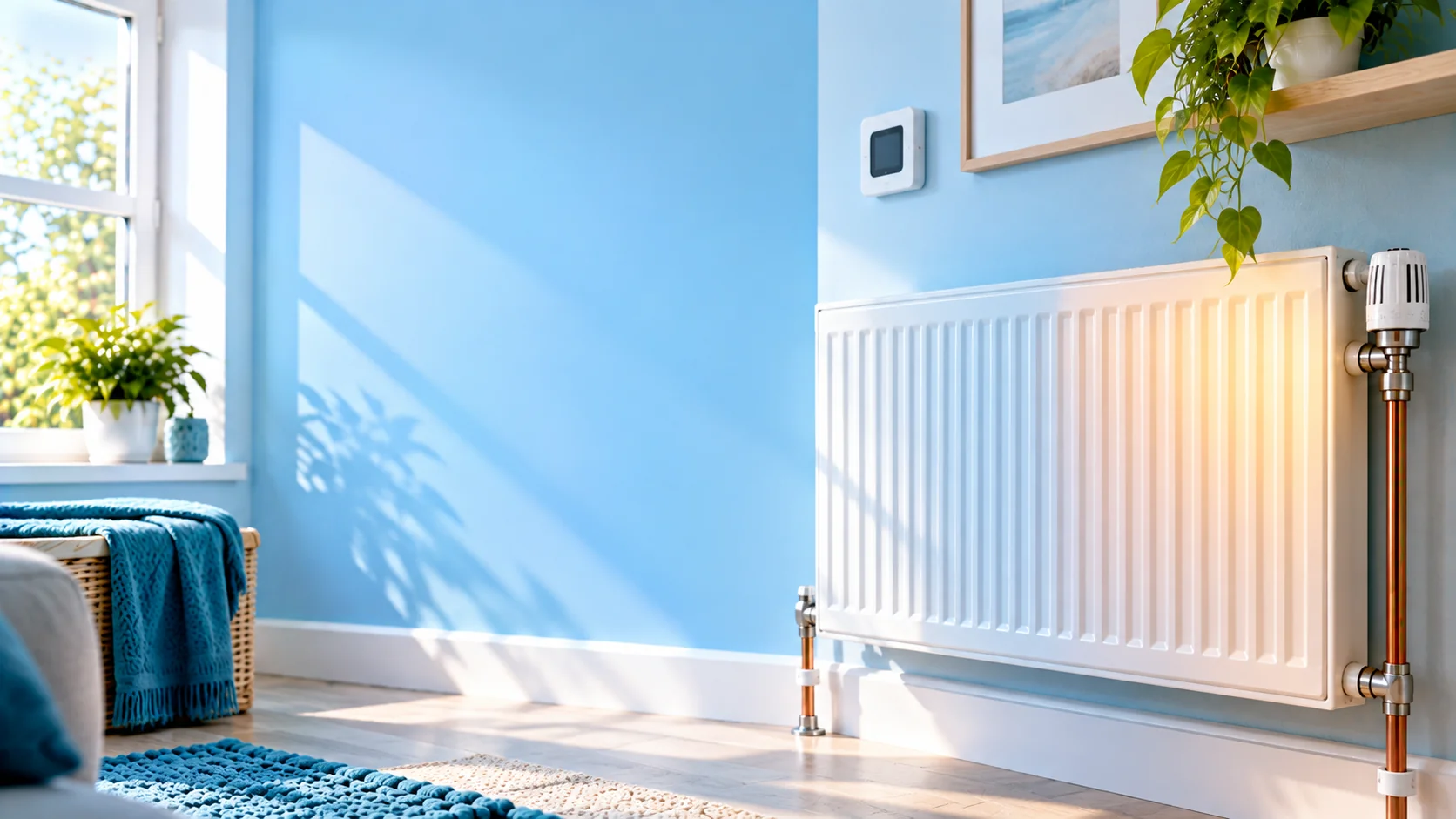
INTERACTIVE RADIATOR DIAGNOSIS
Where has the heat stopped?
Before touching any valve, make sure the heating is actually being asked to run. Compare the affected radiator with other radiators during the same heating cycle. A radiator may be cool simply because its room is already warm enough.
Choose a symptom to see the mechanism and the next safe check.
These results are clues, not a definitive diagnosis. The radiator type, thermostat demand, valve design and time since startup all affect surface temperature.
UNDERSTAND THE SYSTEM
How a radiator receives heat
In a typical UK wet central-heating system, a boiler or other heat source warms water, a pump moves it through heating pipes, and control valves distribute flow to individual radiators. Metal panels then transfer energy from that circulating water into the room. If there is no call for heat, no hot water may leave the heat source. If only one room stays cold, hot water may not be entering or travelling through that radiator. If the radiator is partly warm, a local flow or air problem becomes more plausible.
That is why changing one part without testing the heat path is unreliable. A thermostatic radiator valve (TRV) is a room-temperature control, not a boiler pressure regulator. Its setting may close or restrict the inlet once the surrounding air reaches the selected level. A lockshield or balancing valve at the other end helps control flow distribution and is usually not intended for casual adjustment.

What the drawing does not prove: a cold patch is not a laboratory test for air or sludge. Compare temperature patterns over time and seek a heating professional where the cause remains uncertain.
SAFETY FIRST
When should you stop troubleshooting?
In Great Britain, the National Gas Emergency Service is 0800 111 999. Gas-appliance work requires a Gas Safe registered engineer. For an electric boiler or heat pump, follow the relevant equipment safety instructions and seek an appropriately qualified professional.
START WITH OBSERVATION
Four checks before assuming a fault
- Confirm a heating demand. Check heating mode, timer and room thermostat, then allow sufficient time for the circuit to warm. A correctly satisfied thermostat may not call for heat at all.
- Compare every radiator. Is one cold, one room cold, a whole zone cold, or the entire home cold? That distinction helps locate the fault.
- Inspect external controls only. Note TRV positions and whether a valve appears shut; do not undo pipe fittings or loosen a lockshield on speculation.
- Read the boiler or heating display. Record any fault code and the manufacturer's operating information. If a sealed system has low pressure, read its exact instructions rather than repeatedly topping it up.
Check the room air as well as the radiator. A radiator with a fitted cover, thick curtain or furniture immediately in front may be transferring less heat to the room despite functioning normally.
SYSTEM-WIDE CHECK
If every radiator is cold
When no radiators warm, the likely problem is upstream of any individual radiator: heating demand, programmer, room thermostat, boiler state, zone control, circulation or supply. The fact that a combi boiler still provides hot tap water does not prove the heating branch is operating. Heating and domestic-hot-water requests can use separate controls and flow paths.
Check that the heating programme is active and the thermostat is set above the current room temperature. Check the boiler for a message or lockout; note the exact code rather than resetting repeatedly. If there is no heat after normal control checks, call a heating engineer to assess controls, circulation and heat generation.
ONE RADIATOR COLD
If one radiator is cold all over
If other rooms are warming, focus on the local flow path. A TRV may have reached its setpoint, a manual valve may be turned down, a valve mechanism may be sticking, or water may not be moving effectively through that branch. Low flow can also be caused by air in the circuit or a restriction, but you cannot identify which simply from a cold metal panel.
Turn the radiator's user-adjustable TRV to an appropriate higher setting and allow time for the system to respond. Confirm the room thermostat still calls for heat. Avoid tugging on the valve pin or unscrewing the water-retaining valve body. If the radiator remains cold when surrounding rooms are warming, have the valve and pipework examined. For a single-room focus, see Why Is Only One Radiator Not Heating?.
COOL AT THE TOP
If the top remains cold but the lower panel warms
Air is lighter than water, so trapped air often accumulates near the high point of a hot-water radiator. That stops water from occupying part of the panel and can leave a cool upper strip, sometimes with gurgling. A wet radiator may need bleeding, but first identify the system: US steam radiators use a different arrangement and must not be treated as hot-water radiators.
For a conventional wet radiator, Worcester Bosch recommends turning heating off, allowing the radiator to cool, and using the correct bleed key, cloth and the manufacturer's instructions. Only a small opening is needed; close it when water appears as directed. Check sealed-system pressure afterwards against the manual and do not repeatedly refill a system that keeps losing pressure. See Why Is My Radiator Cold at the Top? for the detailed pattern.
COOL AT THE BOTTOM
If the top warms but the lower panel stays cold
A radiator transfers heat to the room as water moves through it, so the return and lower portions need not feel identical to the inlet. A persistently pronounced cold lower region—especially with poor room heating—can sometimes mean restricted circulation, deposits, or a balancing issue. It is not automatically proof that the radiator is packed with sludge.
Compare several radiators when the system is fully running. Do not drain the radiator, inject cleaners or request an expensive powerflush based on touch alone. An engineer can check flow temperatures, valve operation and whether treatment is genuinely needed. The separate article Why Is My Radiator Cold at the Bottom? explains the more specific temperature pattern.
UNEVEN DISTRIBUTION
If distant radiators warm slowly
Water tends to follow paths of lower resistance. If near-boiler radiators heat rapidly but remote rooms lag significantly, valve settings or hydraulic balancing may be relevant. Flow problems can also arise from an airbound branch, circulator fault or zone-control issue. The quickest-warming radiators are not necessarily the ones most in need of attention.
Note whether the problem affects a whole floor, an extension or a single zone; note heating demand and changes after recent works. Vaillant explains that balancing requires checking the whole system, not just turning one valve fully open. A qualified engineer can assess balancing and pump control without creating new cold rooms.
RADIATOR CONTROLS
If turning the TRV has no effect
A TRV contains a temperature-responsive head and a valve controlling water flow. If a room has already reached the selected setting, the head may deliberately restrict flow. A sticking mechanism can produce a similar symptom when the room is cold and heating is being requested. Some manufacturers permit checking a TRV head, but the correct method varies and the wet valve body must never be loosened.
Check the user controls and record whether neighbouring radiators warm. If the control feels jammed, leaks or cannot be identified, stop and obtain its instructions or a heating engineer's assessment. Valve replacements may require draining and should be completed by a competent installer.
BOILER & PRESSURE
If the boiler display shows a pressure or heating fault
Sealed wet heating circuits need adequate water pressure for circulation. A low-pressure warning can explain poor or absent radiator heating, but the gauge is not a measurement of heat output or the pressure at a hot tap. Compare the cold-system reading with the range printed in the specific appliance manual.
Do not make pressure adjustments blindly. A radiator that needs frequent bleeding or a boiler that repeatedly requires refilling may have a leak or other fault. Read Why Is My Boiler Losing Pressure? and Why Does My Boiler Keep Turning Off? when those symptoms are present.
UK & US SYSTEM TYPES
UK hot-water radiators versus US hydronic and steam systems
Most UK household radiators are wet/hydronic units with pumped warm water and often a TRV. US homes can use hot-water baseboards, hydronic radiators, steam radiators, forced-air heating or electric emitters. The right repair depends on which system is installed.
In a hydronic circuit, circulation depends on adequate flow, appropriate controls and removal of unwanted air by methods specified for the equipment. On a one-pipe steam radiator, by contrast, an air vent and the return path for condensate matter; the supply valve is generally operated as designed, not half-opened as a way of balancing. Do not use a radiator bleed key on an unknown steam emitter. An electric radiator has electrical controls, not a water-filled circuit to bleed.
WHAT TO DO NEXT
Choose the right next step
When all radiators are cold, start with heating controls and the appliance status. When one entire radiator stays cold, review its room demand and user-adjustable valve setting. When only the upper part remains cold in a wet system, assess trapped air and safe bleeding. When several distant emitters underperform, consider distribution and balancing. Book a qualified professional for valve dismantling, persistent air entry, pressure loss, system flushing or internal boiler work.
For a leak, protect the floor, stop the heating if safe and seek assistance; visit Why Is My Radiator Leaking?. For repeated clicking, hissing or knocking see Why Is My Radiator Making Noise?.
FREQUENTLY ASKED QUESTIONS
Radiator not heating FAQs
Why is my radiator completely cold while the heating is on?
If other radiators heat normally, a local valve setting or circulation restriction is more likely. If every radiator is cold, check the heating demand and boiler status first.
Does a cold radiator mean the boiler is broken?
Not necessarily. A cold radiator can result from its thermostatic valve, local isolation valve, trapped air or uneven circulation even when the boiler is providing heat elsewhere.
How long should a radiator take to warm up?
It varies with boiler temperature, pipe layout, radiator size and heating controls. Compare rooms during the same heating call rather than expecting every radiator to become hot at once.
Should I bleed a radiator that is cold all over?
Bleeding is primarily useful where air is suspected, especially a cool upper section. Check the other radiators and valve settings first; a completely cold radiator does not establish an airlock.
Why is my radiator cold at the top but warm below?
Air can collect at the high point and reduce water contact with the upper panels. For a wet radiator, follow the manufacturer’s safe bleeding method after the system has cooled.
Why is the bottom of my radiator colder?
Some vertical temperature difference is normal as heat transfers into the room. Pronounced persistent cold patches can suggest restricted flow or deposits, but touch alone cannot confirm sludge.
Why does one radiator heat only when others are off?
The system may have uneven flow distribution or a local restriction. Rebalancing could help, but a heating engineer should rule out valve and circulation issues.
What is a TRV and can it stop heating?
A thermostatic radiator valve reduces water flow when its room reaches the selected temperature. A low setting or a sticking mechanism can leave the radiator cooler than expected.
Should I remove a thermostatic radiator valve head?
Not as a first troubleshooting step. Head removal procedures vary; do not loosen the valve body or compression nuts. If the control does not respond, consult the fitting instructions or an engineer.
What if all radiators are cold but hot taps still work?
On a combi system the hot-water and heating functions may be controlled separately. Check the heating schedule, thermostat and displayed fault code. A zone or diverter fault may need an engineer.
Can I use the same instructions for US steam radiators?
No. Steam emitters have air vents and condensate paths; they are not bled like sealed hot-water radiators. A steam specialist should investigate persistent problems.
When should I call a heating engineer?
Seek help for leaks, repeated pressure loss, a recurring lockout, major cold areas despite normal controls, persistent banging or a valve that may need dismantling. Never open a gas boiler casing.
MANUFACTURER & SAFETY REFERENCES
Sources and further reading
These sources describe common radiator heating problems, bleeding methods and system balancing. Follow the exact instructions for your own installation.