START WITH THE FROST PATTERN
Where exactly is the ice forming?
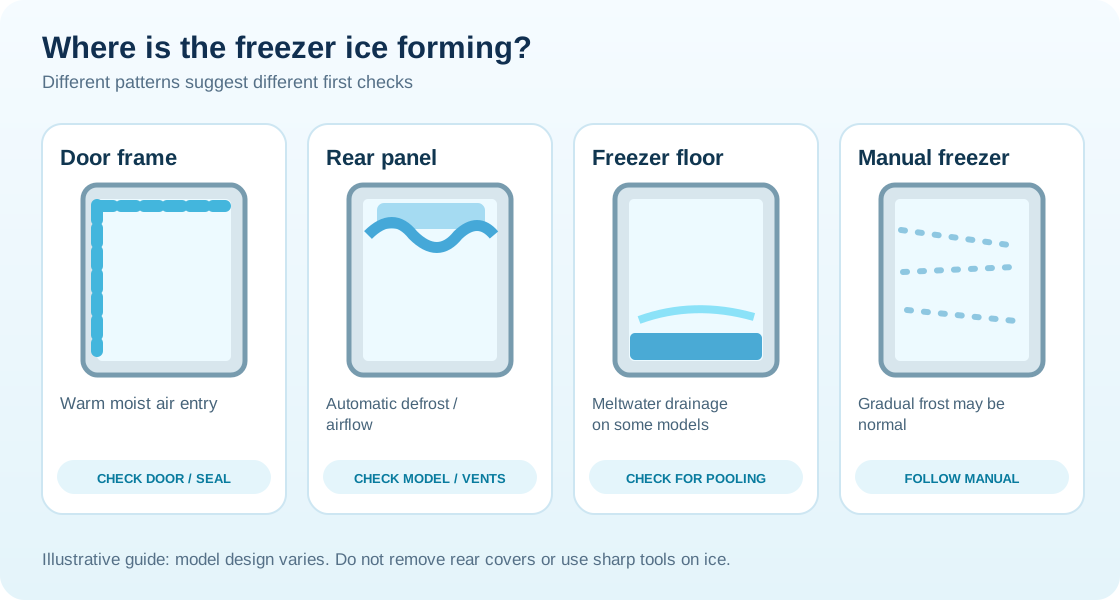
Frost is water vapour from warmer, moister air that freezes on cold surfaces. But the shape, location and speed of the build-up matter. Frost at the door points you towards sealing; a persistent solid ice sheet at the base may involve water drainage; a heavily frosted rear panel in a frost-free model may need a defrost-system diagnosis. These are clues, not proof of any particular failed component.
Choose an ice pattern to see the safest first check and jump to its explanation.
| Ice pattern | Likely mechanism | First check |
|---|---|---|
| Frost at door edge or on top of packets | Humid room air entering through a gap | Door obstruction, seal and drawer alignment |
| Repeated frost behind rear panel | Air leakage, blocked circulation or defrost fault | Check model type, seal and visible vents |
| Thick ice sheet at bottom | Meltwater unable to leave a defrost drain on some designs | Look for repeat pooling; seek model-specific guidance |
| Even light frost on manual-defrost freezer | Expected frost from periodic moisture entry | Manual defrost schedule |
| Frost plus warming food | Cooling or airflow problem possibly developing | Protect food and measure actual temperature |
WHY ICE APPEARS
How does a freezer build up frost?
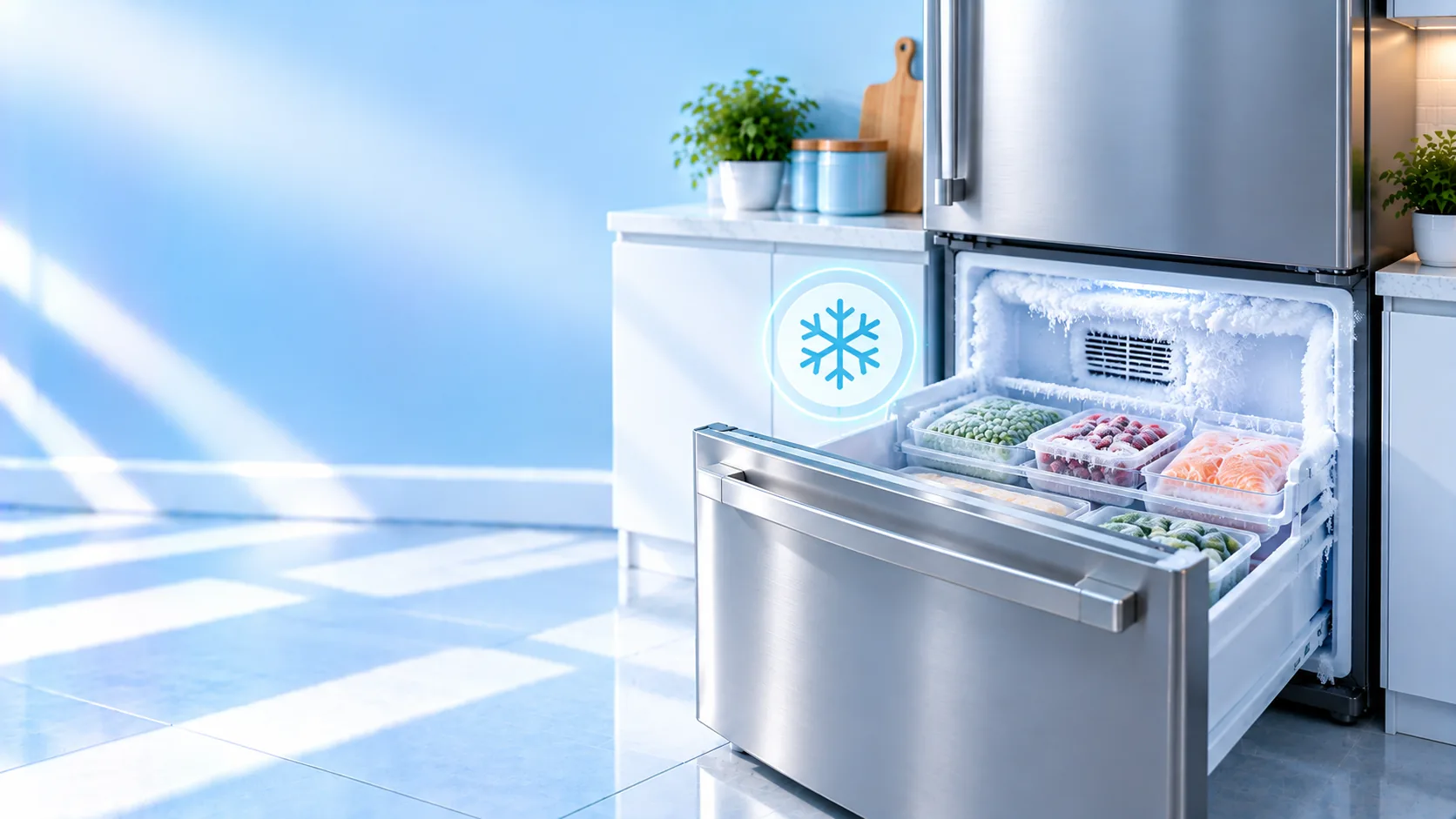
The freezer's refrigeration system removes heat, but it doesn't remove every source of water vapour. When a door opens, warm, moist room air enters and moisture freezes on cold surfaces. Uncovered food, an accidentally open drawer or a deteriorated seal adds more moisture. Repeated entry can produce fluffy white frost on packages and the liner.
In many frost-free appliances an evaporator is periodically warmed by an automatic defrost system. The meltwater should follow a designed drainage route. If the defrost system or drain fails, ice may build up repeatedly, obstructing airflow or creating a sheet on the floor. Not all freezers have the same evaporator arrangement or drain access, so treat the following diagram as conceptual.
COMMONEST EXTERNAL CHECK
1. Why is frost collecting around the door seal?
A package sticking out, a basket fitted incorrectly or a distorted gasket can leave a tiny gap. That gap admits moisture continuously even while the freezer appears shut. Frost often appears nearest the gap and can make the next closure harder, compounding the problem.
Start by removing packages from the door path. Confirm the drawers sit on their runners and the hinge side is unobstructed. When the appliance is safe to access, wipe the accessible gasket and cabinet contact surface with a soft damp cloth, then dry. Examine for tears, folds, loose sections or visible ice. Use only the adjustment and cleaning method specified for your model; don't stretch a damaged gasket or try to heat it with a hair dryer.
One helpful clue: if the frost is concentrated around one corner of the frame, investigate closure at that corner before suspecting a compressor or thermostat. If the seal visibly fails to touch the cabinet after the easy checks, it may need professional adjustment or replacement.
FROST-FREE FREEZERS
2. What does a frosted rear panel mean?
In a frost-free freezer, heavy frost on or behind the rear panel can be caused by humid air entering through the door, by poor air movement, or by a failure in the automatic defrost process. A fan may then struggle to distribute cooled air. You might hear a rubbing or ticking noise, see an abnormal frost patch, or notice frozen food softening even while the compressor runs.
Check the door first; next, make sure visible air outlets are not blocked by tightly stacked food. Do not unscrew the rear panel, probe a fan, or test a heater or thermostat. Technicians may need to assess the defrost heater, sensors, fan and controls. A full manufacturer-approved defrost sometimes restores cooling temporarily, but repeated frost after normal use suggests the root cause remains.
For food that is softening, use the companion freezer not freezing guide and check temperature rather than waiting for visible ice to worsen.
SOLID ICE AT THE BOTTOM
3. Why is there a hard sheet of ice under the drawers?
A smooth ice layer at the bottom is often distinct from fluffy frost. In certain frost-free freezer designs, the appliance periodically melts frost off the evaporator and routes that water to a drain. If the drain freezes or becomes obstructed, meltwater can overflow inside and refreeze into a sheet. It may return after the ice is removed.
This is a model-dependent explanation. First confirm the water isn't entering from an ice-maker supply line or dispenser connection if your refrigerator has one. If water is pooling, unplug for a safe manual defrost only when the manufacturer's instructions allow it and after relocating food. Do not pour boiling water into concealed drain channels or force plastic covers. Persistent bottom ice deserves model-specific appliance service.
Water pooling in the fresh-food compartment instead? The diagnosis may be different; see why a fridge leaks water.
FROST ON PACKAGES
4. Why are food packets covered in white ice crystals?
Air containing moisture may reach packages when the door is opened frequently or is not completely closed. Food with poorly sealed packaging can also acquire ice crystals as moisture moves from food to packaging. Frost inside a container or dried-out patches on the food may be freezer burn—a quality issue rather than necessarily a problem with the whole freezer.
Use airtight, freezer-suitable containers and bags; expel excess air where appropriate and label dates. Cool newly cooked food promptly and safely according to food-safety guidance, rather than leaving it out for long periods. Keep air pathways clear and check that an overflowing drawer is not preventing closure. Look for actual frost on the freezer walls: packaging-only frost and a cabinet coated with ice are different clues.
KNOW YOUR FREEZER TYPE
5. Is frost normal in a manual-defrost freezer?
Yes. A traditional manual-defrost freezer naturally collects frost over time because it does not automatically remove all accumulated ice. Manufacturers recommend defrosting on a model-specific schedule or when frost reaches the thickness stated in the manual. Beko's general guidance mentions around a quarter inch (roughly 6 mm) for non-no-frost appliances, but your manual overrides a generic threshold.
Before starting, move food to another correctly operating freezer or follow local food-safety instructions for temporary cold storage. Switch the appliance off or unplug as instructed. Leave the door open, use towels or a tray for meltwater and allow ice to loosen naturally. Only use a manufacturer-approved plastic scraper if the manual permits. Never jab at ice or apply a heat gun or sharp metal object.
If heavy frost returns immediately after careful defrosting or the door won't seal, treat that as an underlying issue even on a manual-defrost model.
WHEN IT KEEPS COMING BACK
6. Why does ice return soon after I defrost the freezer?
Defrosting removes the symptom, not necessarily the cause. Recurrent frost may be due to a door that doesn't close, repeated warm-air entry, a blocked vent or—for an automatic-defrost model—an actual defrost system fault. A fast return in the same area is more informative than an isolated frost episode.
Take a dated photo of the frost location. Record the freezer type, measured temperature, time to recurrence and whether the doors shut fully. Also note recent power failures or a large food load. These observations help an engineer distinguish a gasket/installation problem from an internal defrost failure without guessing at parts.
FOOD SAFETY MATTERS
7. Is my freezer still keeping food safe?
The recommended frozen-storage temperature is approximately −18°C (0°F). A cabinet that looks icy can still have poor air circulation or warmer areas, so measure with a suitable appliance thermometer. If food is softening or the alarm sounds, keep the door closed while arranging safe storage. Do not taste food to decide if it is safe.
US FoodSafety.gov says food with ice crystals remaining, or at 40°F (4°C) or below, may generally be refrozen or cooked; food held above that limit for more than two hours requires caution and the chart gives food-specific decisions. UK Food Standards Agency guidance recommends approximately −18°C for normal freezer storage and following product instructions. If the food's time/temperature history is unknown, prioritise safety over salvaging it.
A SIMPLE ORDER OF CHECKS
Five safe steps to stop unnecessary ice
- Protect frozen food and photograph the pattern. Note whether the ice is fluffy, concentrated at the door, on the rear panel or solid at the bottom.
- Confirm your freezer type. A manual-defrost model is meant to accumulate some frost; a frost-free model generally should not develop heavy persistent build-up.
- Check door closure and gasket. Clear food and drawer obstructions; gently clean accessible seals.
- Check visible vents and actual temperature. Allow air to move; use a freezer-safe thermometer near the manufacturer-recommended position.
- Follow the manual for defrosting—or seek repair. Don't force ice away. If frost returns rapidly or food cannot stay safely frozen, request a model-specific assessment.
Useful related articles: Refrigeration Problems · Freezer Not Freezing · Fridge Leaking Water.
WHEN TO CALL A TECHNICIAN
When is an engineer needed?
Arrange service if a frost-free freezer repeatedly forms thick rear-panel ice despite correct door closure, a drain appears persistently frozen, a fan rubs against ice, a gasket is torn, or measured storage temperature cannot be maintained. Internal electrical components, refrigerant lines and defrost heaters are not appropriate homeowner troubleshooting areas.
Brand/model, manual-defrost or frost-free type, the location and speed of ice build-up, measured temperature, photos, relevant errors and recent outages.
If a cord is damaged, a circuit trips repeatedly, there is a burning smell, or refrigerant tubing looks punctured, stop using the appliance and get qualified help. Do not attempt sealed-system repairs.
COMMON QUESTIONS
Frequently asked questions
Why is ice forming around the freezer drawer?
A drawer that does not close flush or a worn gasket can let humid air in, creating frost near the opening. Check whether a food package or basket prevents a complete seal.
Can I use a hair dryer to remove freezer ice?
No. Hair dryers and heat guns can damage plastic liners and electrical parts and create safety hazards. Follow the appliance manual's defrost procedure.
Does frost at the back always mean a defrost heater failed?
No. Air leaks, blocked vents and door-opening habits can produce similar frost. A technician needs to test model-specific components before a failed heater is confirmed.
Why is the freezer floor covered with solid ice?
On some frost-free models, blocked defrost-water drainage can cause meltwater to refreeze at the bottom. Check for model-specific instructions; don't remove internal covers blindly.
How often should a manual-defrost freezer be defrosted?
Follow your model's instructions and the indicated frost-thickness threshold. Many require periodic manual defrosting; frost-free units usually do not.
Is freezer burn the same as frost build-up?
No. Freezer burn is dehydration of exposed frozen food that can affect texture and taste. Heavy frost on walls, seals or the rear panel describes ice accumulating in the compartment.
MANUFACTURER AND FOOD-SAFETY REFERENCES
Further reading
These references support general causes and safe checks. Consult the instructions for your exact freezer for defrost procedures, temperature settings and accessibility.
- LG UK: How to defrost a freezer — causes and safe defrosting.
- LG US: Freezer frost and icicles — gaskets, drawers and humidity.
- Whirlpool: Frosting in freezer section — door use, sealing, airflow.
- Beko: Preventing freezer frost — manual versus no-frost and correct loading.
- Samsung: Frost in freezer or ice bucket — frost location and door gaps.
- iFixit: Whirlpool freezer ice — troubleshooting mechanisms and repair context.
- UK Food Standards Agency: Chill, freeze and defrost safely.
- US FoodSafety.gov: Food safety during power outages.
General educational guide, not a model-specific diagnosis. Frost patterns are clues only. Food safety and manufacturer safety precautions take priority.