INTERACTIVE EIGHT-OPTION DIAGNOSIS
What is your heat alarm doing?
Select the closest situation for the appropriate safe next step. This tool cannot determine whether a building is safe. For any active or unexplained full alarm, evacuate before investigating.
QUICK ANSWER
Why does a heat alarm keep sounding?
A heat alarm activates because its heat sensor detects a high local temperature, or because an interconnected alarm elsewhere has triggered it. An occasional short chirp may instead indicate low battery, mains supply trouble, end of service life or an electronic fault. These are different situations requiring different responses.
A heat detector usually does not react directly to ordinary smoke or steam particles. It responds to temperature. Strong rising heat from a hob, oven, open grill, heater or nearby machinery may reach the detector even when the room as a whole feels comfortable. Some units are designed for fixed-temperature detection, while others combine a temperature threshold with rate-of-rise sensing; never assume all devices trigger at one identical temperature.
First treat a loud fire-alarm signal seriously; then, once safe, use the device model, its location, the heat sources in the room and interconnection history to identify the cause.
SAFETY FIRST
What to do when a heat alarm sounds loudly
Alert other occupants and follow your fire escape plan. Leave the building promptly if fire is possible, the source cannot immediately be established safely, or connected devices are sounding. Close doors behind you if safe. Call emergency services from outside: 999 or 112 in the UK; 911 in the US. Do not search a smoke-filled or potentially burning area, repeatedly press hush or re-enter just because a siren stops.
In a purpose-built block of flats, follow the building’s fire strategy and emergency responder instructions. If smoke or flames obstruct escape, close yourself in a safer room and call the emergency services. The priority is personal safety, not identifying the exact detector.
A detector that has stopped sounding is not proof that a hazard has ended; a short-lived high-temperature event may still need professional assessment.
HOW IT WORKS
A heat sensor measures local temperature, not smoke
Many domestic heat alarms contain a thermistor, an electronic component whose resistance changes with temperature. The alarm monitors the signal and decides whether it has reached its model-specific activation condition. Some devices also respond to a sufficiently rapid temperature rise. Aico’s Ei144e and Ei3014 models state a trigger at approximately 58°C; FireAngel’s FA6720-R is rated in the 54–65°C range. Neither figure describes every detector or every installation.
Because warm air rises, the temperature immediately under the ceiling may be higher than the temperature someone feels standing in the room. A heat alarm can therefore be influenced by its position relative to a cooking appliance, heating outlet or poorly ventilated hot area. That does not make a repeated activation harmless.

Heat alarms can be appropriate for kitchens, garages and other places where smoke-sensing alarms would have frequent nuisance activations. They complement rather than replace smoke alarms required in the living and escape areas of a home.
PATTERN 1
Heat alarm goes off while cooking or opening the oven
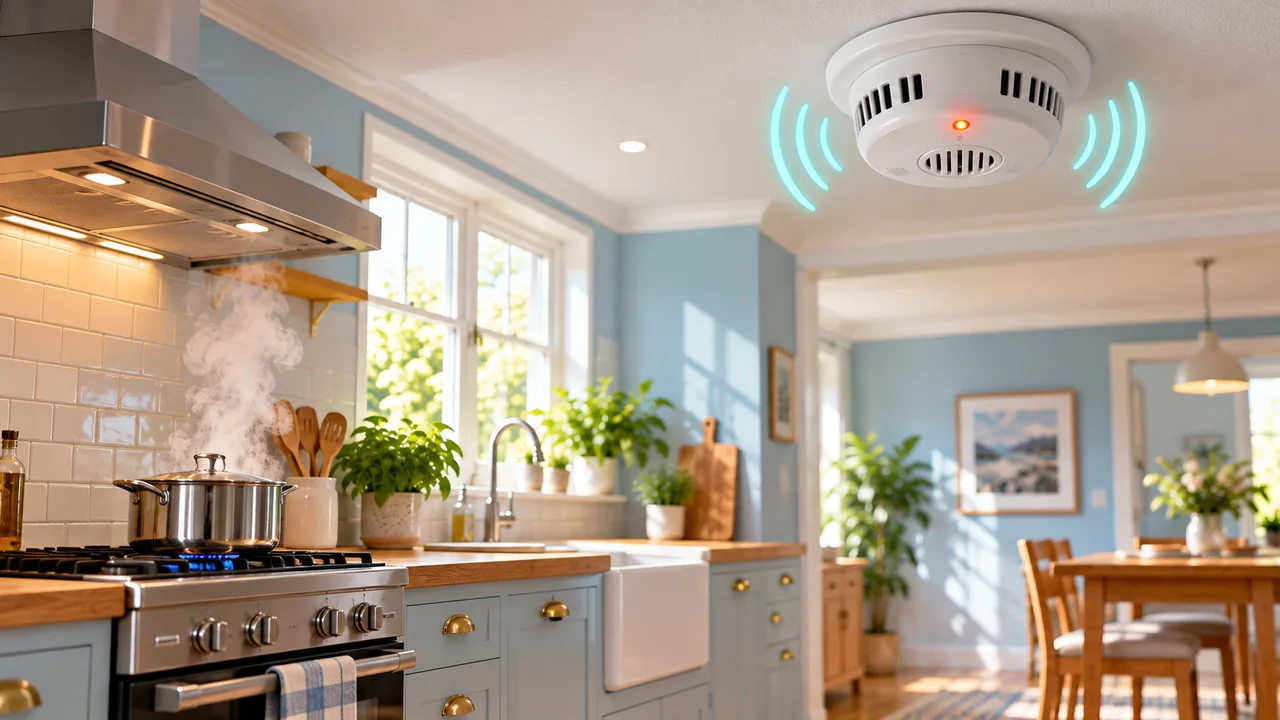
The rush of hot air from an oven, a long high-temperature cooking session or a hot hob beneath the detector can create a local ceiling-temperature spike. Steam is not generally what a heat sensor measures, although steam and cooking can coincide with hot rising air. A hot extractor duct or heat source directly beneath the detector can concentrate this effect.
Once the property is confirmed safe, record which cooking action preceded each event and whether the alarm is directly above or unusually close to the appliance. Avoid changing the position or detector type yourself in a way that breaches fire protection or local regulations. An installer can compare the actual position with the alarm’s siting manual and fire-safety requirements.
Do not cover the detector, disconnect its power or permanently disable it to prevent cooking-related activations. If cooking regularly triggers a heat alarm, an incorrectly situated sensor or a fault deserves professional review.
PATTERN 2
Why do all the heat and smoke alarms go off together?
Many alarms are hardwired or wirelessly interconnected. When any single unit detects a qualifying condition, it can transmit an alarm signal so every linked sounder operates. The kitchen heat alarm may be sounding even though the initiating sensor is a smoke alarm in another room.
After the emergency has been resolved, consult the interconnection system instructions for the initiating-device indicator or event log. Aico systems may use a rapidly flashing red indicator on the initiating device, but signalling varies. A separate alarm controller or manufacturer app may identify the source more reliably.
If false activations continue, ask the installer to check interconnection, house coding, compatibility and system history. Avoid resetting or rewiring interconnected devices yourself; incorrectly configured links may compromise detection elsewhere.
PATTERN 3
Heat alarm sounds in the garage, loft or utility room
Workshops and garages may contain engines, appliances, heating equipment or poorly ventilated pockets of hot air. Some heat alarm models are suitable for these spaces, but each has minimum and maximum operating temperatures and particular siting requirements. A unit designed for a domestic kitchen may not be approved for a location that freezes or becomes extremely hot in summer.
After the building is safe, note whether activations occur during use of a heater, tumble dryer, vehicle or other heat-producing equipment, and compare the installed detector model with the manufacturer’s room suitability and temperature rating. A machine or flue that overheats is itself a potential fire hazard: do not dismiss a heat alarm as an inconvenience.
Consult a qualified fire-alarm installer if environmental temperatures fall outside the alarm’s operating range or if activation persists without a credible heat source.
PATTERN 4
A short periodic chirp is not the same as a full heat alarm
A small single chirp every few dozen seconds or every minute is often a maintenance indicator. Possible causes include a depleted replaceable battery, an expired sealed cell, end-of-life warning, missing mains power or an internal self-test fault. The interval, LEDs and number of chirps are specific to the manufacturer and model.
Check the product label or paperwork for the model and replacement date. For a confirmed maintenance alert, follow its exact instructions. A sealed long-life battery usually requires replacement of the complete alarm; a mains-powered model may have a replaceable backup cell, but an electrical installer should address wiring problems.
Never interpret an unknown loud, repeating warning as a mere low-battery beep. If you cannot confidently distinguish them, prioritise the emergency response.
PATTERN 5
Why might a heat alarm sound unexpectedly at night?
A night-time full alarm needs the same emergency response as a daytime alarm. An actual fire or appliance overheating may be difficult to see initially. A linked alarm elsewhere may also be the source. Do not assume that sleeping occupants, darkness or an absence of cooking means the sound is a detector malfunction.
Once professionals have confirmed the property is safe, examine whether the initiating detector has a recorded event, whether the heating or cooking equipment cycles overnight, and whether the alarm has exceeded its recommended service life. Sudden fault signals and periodic low-battery chirps can be more noticeable in the quiet of the night, but a loud full alarm is never something to simply silence and ignore.
PATTERN 6
Alarm repeats after using hush, cleaning or testing
The hush button is a temporary function on some alarms, not a repair. If the unit immediately resumes a full alert, temperature may still be elevated, an interlinked device may still be sounding, or the detector may be malfunctioning. Never repeatedly hush an unexplained fire warning.
In a safe setting, check the exact cleaning method permitted by the manufacturer; some devices allow gentle exterior vacuuming, but opening the sensor housing, spraying cleaners into vents or heating it artificially can damage the unit. Use the test function only as documented, and do not apply flames, boiling water, hairdryers or other improvised heat sources to test a detector.
Repeated activation without a verified heat source calls for manufacturer support, a competent installer or replacement with an appropriately compatible device.
PATTERN 7
I cannot tell which alarm or detector is sounding
A domestic property can contain smoke, heat and carbon monoxide detectors with similar white housings. Some combined devices have different tones for fire and CO, while interconnected systems can sound in rooms away from the initiating detector. The name or printed label is more reliable than visual appearance alone.
Do not walk through a potentially unsafe building searching for an initiating device. Once safe, note the detector make/model, any alarm controller display and recent event history. A building-wide or commercial system should be investigated by the responsible person or qualified alarm contractor.
Where the signal may be from a CO detector, follow the CO emergency instructions rather than the maintenance procedure for a heat detector. An unfamiliar or repeating alarm must be treated as a safety warning first.
DIAGNOSIS MAP
Four different reasons a heat alarm appears to activate unexpectedly
Each explanation points to a different source. A genuinely high local temperature is different from an incorrectly positioned detector. An interconnected sounder can simply be repeating an alert from another unit, while a maintenance chirp or electronic fault may sound without heat. Never guess from one indicator light.

SAFE PREVENTION
How to reduce nuisance activations without losing protection
- Use the correct approved detector for each room. Heat alarms are intended for certain locations where smoke alarms may not be appropriate, but they do not substitute for required smoke detection throughout a home.
- Follow the unit's ceiling-location clearances and avoid direct heat plumes; ask an installer before relocating a linked or mains-powered unit.
- Keep ventilation and heat-producing equipment properly maintained. A hot appliance or obstructed extraction route should be checked rather than dismissed.
- Test alarms at the manufacturer’s stated interval using their test buttons, not a flame or improvised heat source.
- Replace devices at their documented end of life, and maintain the correct interconnection when replacing a unit.
- Use an alarm log: dates, affected device, cooking/heat sources, and any indicator or error code. This can help an installer diagnose a recurring problem safely.
A heat alarm that activates persistently despite correct placement and no verified heat source may require replacement or specialist fault finding. Never permanently silence or remove a detector just to keep a room quiet.
UK AND US
Heat-alarm terminology and safety requirements differ
UK: Domestic heat alarms commonly appear in kitchens and can be interconnected with smoke alarms; Aico and FireAngel models are prominent. Some have specified fixed-temperature triggers near 58°C, but actual approved designs vary. Check UK and devolved-nation fire safety rules and the exact product siting manual. Call 999/112 from safety for a possible fire.
US: The phrase heat detector is common in alarm systems and fire-safety equipment, while a standalone heat alarm is a particular product type. Heat detection may use fixed-temperature or rate-of-rise technologies. US Fire Administration guidance advises that garage alarms be selected for garage temperature conditions; a low-threshold detector intended for another room can be unsuitable there. A heat detector is not a substitute for required household smoke alarms; follow local codes, the listing and manufacturer instructions. For a fire emergency call 911.
Threshold numbers, warning tones, regulatory listings, required placement and service life differ between devices and jurisdictions; use the installed product’s label and professional advice, not a generic online beep chart.
COMMON QUESTIONS
Heat alarm questions answered
Can steam trigger a heat alarm?
Heat alarms primarily sense temperature rather than steam particles. Steam may accompany rising hot air; local heat rather than the water vapour itself can be the trigger.
What temperature sets off a kitchen heat alarm?
It depends on the model. Some Aico units trigger at 58°C and FireAngel FA6720-R at a specified range of 54–65°C. Other devices may differ.
Why does my heat alarm sound when I open the oven?
A burst of very hot air can rise to a nearby ceiling detector. Treat the warning as genuine initially, then have the placement reviewed if it recurs.
Are heat alarms supposed to beep every minute?
Some chirp periodically to report low battery, fault or end of life. Check the exact model manual; a full repeating fire alarm is different and needs an emergency response.
Can a heat alarm go off with no fire?
Yes, local heat, an interconnected alarm elsewhere or an equipment fault can cause an activation. Do not assume the building is safe until a fire has been ruled out.
Should I put a heat alarm directly above my cooker?
Follow the device siting instructions and local fire safety standards. Direct hot-air plumes can cause unwanted alarms; ask a competent installer before relocating it.
How can I find the alarm that started an interconnected alert?
Some systems record the initiating unit or flash an indicator; methods differ. After the emergency is resolved, check the manufacturer manual or alarm controller.
Can a bad battery set off a full heat alarm?
A low battery usually produces a distinct maintenance warning, but exact electronics and sound patterns vary. Never classify an unknown loud signal as harmless.
How do I clean my heat alarm?
Only use the exterior cleaning method specified by the manufacturer after confirming it is safe. Do not open the sensing electronics or spray cleaning products into vents.
How long does a heat alarm last?
Follow the replace-by date and model specification. Some modern devices are intended for about ten years, but that is not a universal lifespan.
Does a heat alarm replace a smoke alarm?
No. Heat detection is generally complementary, particularly in kitchens or garages. Required smoke alarms elsewhere provide earlier warning of smoke in many fires.
What if the heat alarm sounds again after I silence it?
Treat recurring loud activation as a possible emergency. Seek professional investigation after occupants are safe; do not repeatedly silence or disable the detector.
AUTHORITATIVE REFERENCES
Heat-alarm and fire-safety references
Use the exact manufacturer instructions for your device and local fire-safety rules. These references describe typical mechanisms; none can certify an installation remotely.
- Aico: Ei144e heat alarm, 58°C and interconnection
- Aico: heat and smoke alarm fault-finding
- Aico: product FAQs and alarm signals
- FireAngel: FA6720-R heat alarm and siting
- FireAngel: chirping and maintenance guidance
- US Fire Administration — Heat alarms for garages and appropriate temperature ratings
- Kidde — US HD135 heat alarm and interconnection
- London Fire Brigade: household fire escape advice