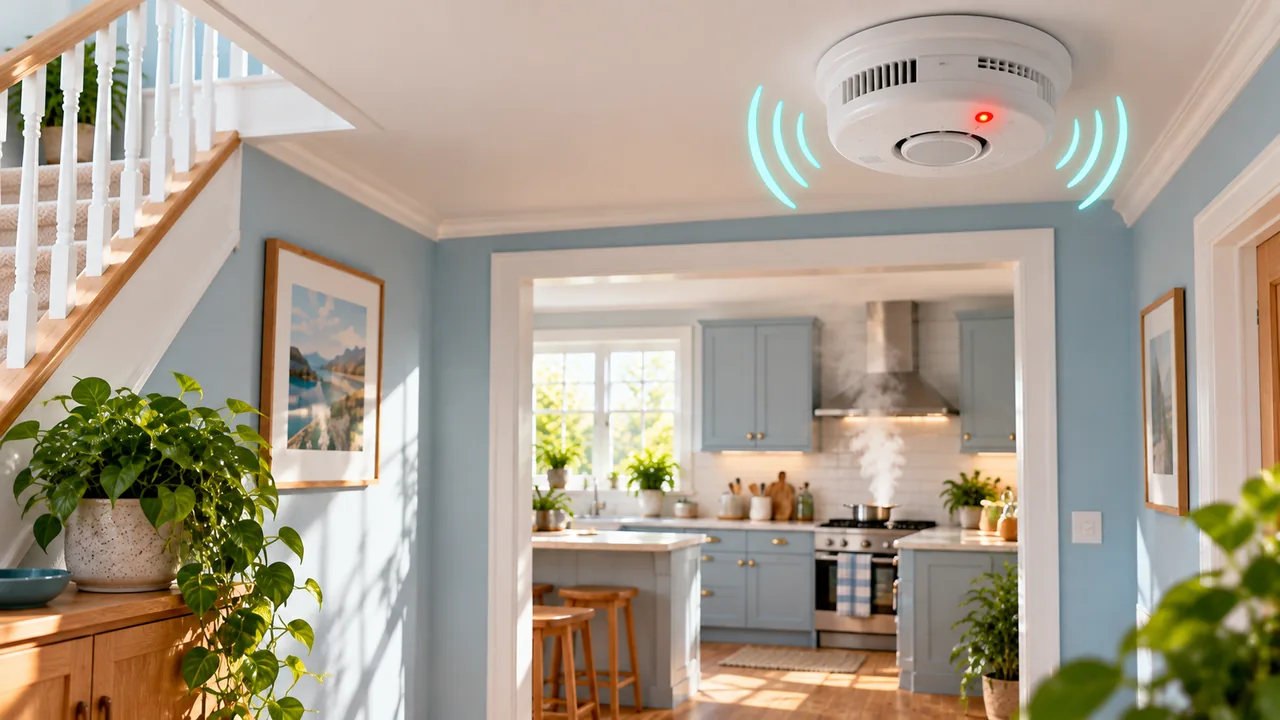
INTERACTIVE EIGHT-OPTION DIAGNOSIS
What was happening when the smoke alarm went off?
Choose the closest situation to see a starting point and a link to the full explanation. This tool cannot decide whether a building is safe: treat an unexplained full alarm as a real emergency first.
QUICK ANSWER
Why does a smoke alarm sound when there is no visible smoke?
A smoke alarm can activate without an obvious fire because its sensor responds to tiny airborne particles or droplets, not to flames themselves. Cooking aerosols, shower steam, dust, insects and misplaced alarms are frequent causes of unwanted activation. Another detector in an interconnected network may have activated first, or a defective or ageing unit may be issuing an alarm.
But "no visible smoke" is not proof of a false alarm. Smoke may be hidden behind a door, in a roof space or from a developing electrical fire. Treat any full alarm as a potential emergency until everyone is safely outside and the situation has been assessed. If it is unquestionably a nuisance activation and the building is safe, investigate the timing, location, initiating detector and manufacturer instructions.
SAFETY FIRST
What should you do when a full alarm sounds?
If the alarm is sounding now, move everyone outside first. If there is smoke, a burning smell, heat, any sign of fire, a CO warning, someone feels unwell, or you cannot establish safety, stay outside and contact emergency services: 999/112 in the UK or 911 in the US. Do not go room to room looking for the source while an unknown full alarm continues.
If a professional or the circumstances establish that the building is safe and the alarm is an unwanted activation, follow the unit's manual for the Hush/Silence control. Hush is temporary: it is not a repair, and an alarm that reactivates needs investigation. Never cover, disconnect or permanently remove an alarm to stop false activations.
A combined smoke/CO unit can use distinct patterns or voice warnings; the meaning depends on the model. A possible carbon monoxide warning is a reason to evacuate even when there is no smoke.
HOW THE DETECTOR WORKS
Why can steam, cooking and dust trigger a fire alarm?
Photoelectric smoke sensors illuminate a small sensing chamber and monitor changes in scattered light. In some conditions, aerosol droplets or particles from cooking, water vapour condensing into tiny droplets, dust and insects can disturb the chamber sufficiently to activate the alarm. Ionisation alarms use a different detection principle and can also respond to particles from everyday activity.
The alarm is designed to respond to a measured condition inside its sensor; it cannot know whether every particle came from a fire. That is why placement, ventilation and clean sensing chambers matter as much as the model's alarm technology.

Heat detectors work differently: they are meant to respond to a temperature condition rather than smoke particles, which is why a suitable heat alarm is often used in kitchens. Do not swap smoke protection for heat detection in an arbitrary location; the correct mix and placement must follow local fire-safety guidance.
COMMON CAUSE 1
Alarm goes off during cooking or just afterwards
Frying, grilling, burnt toast, oven cleaning and even cooking that looks smoke-free can create aerosols that travel across a ceiling. An extractor, open door or ventilation pattern may carry them into a hallway, activating an alarm outside the kitchen.
First, rule out a real cooking fire. Once safe, improve the kitchen's extraction and ventilation, prevent food from burning, and inspect the alarm's documented placement relative to the cooking area. In the US, NFPA guidance recommends positioning smoke alarms at least 10 ft (about 3 m) from cooking equipment where practical, subject to current local requirements and the manufacturer's directions.
If false activations happen regularly during normal cooking, ask an installer whether the location or alarm technology should change. Do not move an alarm so far that required fire coverage is lost.
COMMON CAUSE 2
Alarm sounds after a shower or boiling water
Water vapour itself is invisible, but steam condensing in cooler air forms tiny droplets. A bathroom door opened just after a hot shower can send a cloud into a landing or nearby corridor, where it may affect an optical alarm. Boiling pans, kettles and humidifiers can produce similar conditions.
Look for a repeatable link between high humidity, airflow and activation. Once everyone is safe, improve extraction and inspect whether the alarm is too close to a humid room or draught. Follow the manufacturer and local fire-safety service's placement rules rather than covering vents or relocating protection on impulse.
COMMON CAUSE 3
False alarms began after dust, insects or decorating work
Sanding filler, sawing, decorating, vacuuming a dusty loft and drilling can release enough fine material to settle inside an alarm. Small insects or webs in sensor openings can also interfere with readings. Some affected alarms trigger sporadically rather than every time the room is dusty.
After confirming there is no fire, use the model-specific cleaning method: manufacturers commonly permit careful vacuuming around exterior vents with a soft brush, while others specify compressed air. Do not spray water, solvent, insecticide or cleaning chemicals into the alarm. Do not open the sealed sensor chamber.
Test the alarm using its own Test button after cleaning as instructed. If contamination is heavy, the device is damaged, or activations return, replacement may be more reliable than repeated cleaning.
COMMON CAUSE 4
Could sprays, fragrance or unusual airflow be responsible?
Aerosol deodorants, cleaning mists, polish, incense and some air fresheners can add particles to the air near a smoke alarm. Draughts from heating outlets, ceiling fans or open loft hatches can carry cooking or dust aerosols toward the sensor even when the source is several rooms away.
Observe whether the full alarm repeatedly follows a particular activity. Once safe, reduce aerosol exposure, direct ventilation away from the detector and check installation requirements. Avoid using sprays to "test" the alarm; only approved test methods should be used.
FOLLOW THE NETWORK
What if every connected smoke alarm goes off at once?
Interconnected smoke, heat and sometimes CO alarms are designed to spread a warning throughout the home. The loudest alarm is not necessarily the initiating unit. If one detector sees a qualifying condition, other units may repeat the signal. A corridor alarm may therefore sound when the original condition is in another location.
Once it is safe, locate the originating unit using its model-specific rapid LED sequence, voice location or alarm-memory indicator. Kidde and Aico describe these features on some models, but do not assume a red flash always identifies the initiator. Read the exact model manual and record which detector activated, its location and the conditions at that time.

For large interlinked systems, repeatedly disconnecting alarms or changing House Code settings can leave the network unreliable. Refer persistent faults to the system installer or manufacturer.
ALARM AT NIGHT
Why would a full smoke alarm activate at night?
Alarm timing alone cannot identify the cause. Night-time activation may coincide with a heating cycle, airflow changes, humidity, insects or an intermittent sensor fault—but hidden fire is also possible. Do not dismiss a loud night alarm as a weak battery; a battery warning is typically a short maintenance chirp, not a full evacuation pattern.
After the house is safely assessed, note which device initiated, whether showers or cooking occurred earlier, the age and model, and whether a ventilation system switched on. If the pattern cannot be explained, have the alarm and relevant area checked promptly rather than waiting for the next occurrence.
MAINS & SYSTEM ISSUES
Can a power cut or hardwired alarm fault cause repeated full activation?
Some mains-powered units use a battery backup and interconnection circuitry. Manufacturer guidance notes that power interruptions, poor installation connections or faulty electronics can cause abnormal behaviour in certain models. This is not a reason for homeowners to remove covers or handle mains connections.
If the problem follows a power interruption, identify the model, check for its documented power/fault indicators from outside the casing, and contact the installer if the alert repeats. A full fire signal still needs emergency assessment first.
WHEN CLEANING DOES NOT HELP
Why does the alarm keep activating after cleaning?
If false alarms continue when the air is clear, after manufacturer-approved cleaning and after a sensible review of placement, the unit may be contaminated internally, damaged, unsuitable for its location or nearing the end of its service life. Many domestic smoke alarms should be replaced around ten years from manufacture, but follow the exact product label and applicable requirements.
Consider both the detector and the wider system: is another interconnected unit actually initiating, is moisture returning, or is the device issuing a different warning? Replace a confirmed faulty or expired detector with a compatible approved unit, and arrange professional checks where needed. Do not defeat interconnection or leave an area unprotected.
PRACTICAL CHECKLIST
What are the safest steps once a real fire has been ruled out?
- Identify the alarm. Find the exact model and whether it is smoke, heat or combination smoke/CO.
- Describe the sound. Distinguish a repeating loud evacuation alarm from an isolated maintenance chirp.
- Check the source. For connected systems, consult the model's initiating-device indication or event log.
- Recall the conditions. Was anyone cooking, showering, spraying cleaner or sanding nearby?
- Clean only as directed. Use the published exterior cleaning method and test the device afterwards.
- Check placement and age. Compare with the manufacturer's requirements and the unit's replacement date.
- Escalate persistent activation. Ask an alarm specialist or electrician to inspect an unexplained or hardwired fault.
SPOT THE DIFFERENCE
False alarm, emergency alarm or maintenance chirp?
| What you notice | What it may indicate | What to do |
|---|---|---|
| Repeated loud full alarm | Fire, CO alert on a combination unit, or nuisance activation | Evacuate if unknown; emergency help if danger is possible |
| Single short chirp at intervals | Battery, fault, end of life or model-specific service warning | Use the smoke alarm beeping guide and exact manual |
| Full alarm while frying | Cooking particles reaching the sensing chamber | Check for fire, then ventilation and approved placement |
| All interlinked units sound | One detector caused the network-wide warning | Evacuate, then safely identify the originating alarm |
| Full alarm repeats with clear air | Contamination, damage, installation or system fault | Arrange prompt model-specific service or replacement |
These descriptions are broad patterns, not universal beep codes. Combination alarms and different models use different signal sequences.
UK & US GUIDANCE
Do UK and US smoke alarm rules differ?
Yes. Installation and interconnection requirements vary by country, building type and region. UK homeowners should consult their local fire and rescue service, landlord obligations where relevant, and BS EN 14604-compliant product instructions; kitchens may use suitable heat alarms. In the United States, NFPA recommends smoke alarms inside bedrooms, outside sleeping areas and on every level, with appropriate separation from cooking appliances.
Do not treat online placement distances as universal for every building. Correct positioning and replacement must match the applicable local code and product specification. Both countries prioritise working alarms, monthly testing where recommended, and never disabling nuisance-prone units.
FREQUENTLY ASKED QUESTIONS
Smoke alarm going off for no reason: FAQs
Can a smoke alarm go off when there is no fire?
Yes. Cooking aerosols, condensation droplets, dust, insects and faults can trigger unwanted activation. But no visible fire is not proof that a full alarm is false; respond as an emergency until safe.
Why does my smoke alarm go off after a shower?
Moist air condensing into droplets may enter the optical sensor. Check for a genuine emergency first, then examine humidity and placement against the product instructions.
Why does my alarm go off while frying?
Frying generates particles that can reach an alarm through airflow, even if no thick smoke is visible. Improve extraction and check siting without compromising required coverage.
Should I remove the battery if it keeps sounding?
No. Do not disable protection. Follow approved temporary Hush instructions only after the alarm is confirmed to be a nuisance event, and repair or replace the cause.
Can dust from renovation set it off?
Yes. Sanding, drilling and debris can contaminate the sensing chamber. Clean only as the manufacturer permits and replace badly contaminated or faulty units.
Why do all my interconnected alarms sound together?
Interconnection deliberately relays one originating unit's warning through the network. After evacuation and confirmation of safety, identify the initiating alarm using its model-specific indicators.
Why does it happen at night?
Airflow, humidity, insects or faults may be involved, but night-time alarms are not automatically low-battery chirps. Treat a full alarm as a possible emergency every time.
Do photoelectric alarms ever false alarm?
Yes. They are designed for smoke sensing but can still respond to certain droplets, particles, dirt and other environmental conditions.
Can hairspray or air freshener set it off?
Aerosols from sprays may affect some sensors. Avoid spraying near detectors and investigate repeated patterns without disabling the alarm.
Will pressing Hush fix the problem?
No. Hush temporarily reduces or pauses the alarm according to the model. A recurring cause should be corrected, and Hush is not a substitute for emergency assessment.
Should a ten-year-old detector be replaced?
Many domestic smoke alarms have a roughly ten-year service life. Check the precise replace-by date and manufacturer's instructions; older or faulty units should be replaced promptly.
What if the alarm may be carbon monoxide?
Leave the building and contact emergency services. Combined smoke/CO models can use separate patterns or voice warnings; do not assume absence of smoke makes the situation safe.
AUTHORITATIVE REFERENCES
Manufacturer and fire-safety sources
Use the instructions for your exact model when interpreting LED codes, Hush behaviour, placement and replacement.
- FireAngel — Top 10 reasons a smoke alarm sounds randomly
- Aico — Basic alarm fault finding and interconnection
- Kidde US — Alarm sound, beep and chirp causes
- Kidde US — Responding to nuisance alarms
- Kidde UK — False alarm and sensor contamination
- NFPA — Smoke alarm placement and testing
- US Fire Administration — Smoke alarms and fire safety
- FireAngel — Maintenance chirps versus other sounds