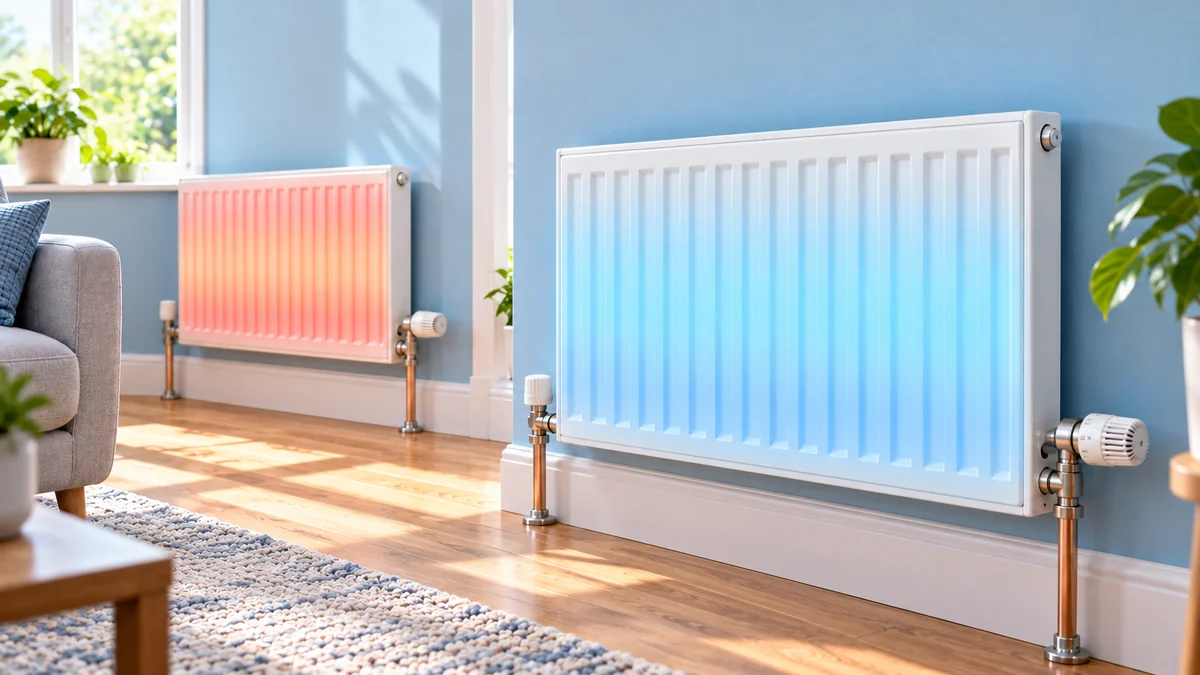
INTERACTIVE EIGHT-OPTION SYMPTOM FINDER
What is different about this radiator?
Start with a normal call for heating: are several nearby radiators warm while this one remains cold? Let the system run long enough to respond, then observe its pattern without touching hot metal or dismantling anything. The same complaint can have several different mechanisms.
Choose an observation for the likely mechanism and a relevant next step.
System type: This guide mainly covers fixed, water-filled (hydronic) radiators. A portable electric radiator, electric baseboard heater or one-pipe steam radiator has different controls and risks. Do not open their enclosures or use hot-water bleeding instructions on steam equipment.
THE RIGHT ORDER
Six first checks before calling a heating engineer
- Check that heat is actually being requested. Ensure the central-heating programme is on and set the room thermostat above the current room temperature. In a zoned home, check the thermostat responsible for this area, not another zone.
- Compare more than one radiator. If several are cold, investigate heating demand, controls and system distribution before blaming one radiator. If most are hot, focus on the affected branch or radiator.
- Look at the user-adjustable radiator valve. A numbered TRV on a UK radiator may be on frost/off or set below room temperature. Turn it up using the ordinary control; give it time to respond. A warm room can legitimately cause its TRV to close.
- Check for evidence of recent isolation. Did decorating, radiator removal, new TRV fitting or another plumbing job precede the fault? Tell the engineer. A lockshield may have been left closed, but do not blindly wind it wide open — it is a balancing adjustment.
- Notice the cold region. A genuinely cold upper band with a warm lower portion suggests trapped air. A modestly cooler bottom may be normal heat transfer; a persistent sharply cold area can indicate low flow or deposits.
- Record boiler status and visible gauge readings where relevant. In a sealed wet system, follow the manufacturer's pressure guidance. Do not repeatedly repressurise a leaking system or open the boiler case. If water is leaking, electronics are wet or noises are severe, stop and seek appropriate help.
MECHANISM FIRST
How can one radiator stay cold when the boiler works?
In a common UK two-pipe wet central-heating system, a pump moves hot water through branches. Each radiator needs a heat demand, an open flow route, enough pressure difference and free passage for water to return. When all those conditions exist, the radiator transfers energy into the room. A closed local valve or significant restriction can interrupt one branch without stopping the other branches.
The boiler producing heat tells you that at least part of the system works; it does not prove that every radiator branch, zone valve, circulator or local thermostat is working. Other heating layouts — including microbore, single-pipe, diverter-tee and zoned systems — can produce different symptoms.

Because water follows paths with differing resistance, a nearly closed valve, trapped air, undersized branch or incorrect balance can mean one radiator receives too little circulation to heat normally. Temperature taken from a single pipe or the top of the panel cannot reliably distinguish every cause.
COMPARE THE PATTERN
What the heat pattern tells you — and what it cannot
| Observation | What it suggests | Useful next action |
|---|---|---|
| One whole radiator cold, others hot | Local TRV setting, stuck valve, closed lockshield, zone/branch restriction | Check ordinary control settings and recent work; inspect for leaks, then request an engineer if unresolved |
| Top cool, lower area warm | Air trapped at the high point of a wet radiator | Follow the radiator/boiler manufacturer's safe bleeding instructions if appropriate |
| Top hot, bottom cooler | Normal heat removal or possible poor flow/deposits if an unusually sharp persistent cold patch | Compare with similar radiators after a full call for heat; avoid automatic power-flush assumptions |
| One inlet pipe hot, panel cold | Local valve or flow restriction, but flow direction and conduction vary | Do not loosen the union; request valve/branch testing if settings are correct |
| Last/furthest radiator heats only when others close | Poor distribution, imbalance or high branch resistance | Ask for system balancing/flow assessment rather than random lockshield changes |
| All emitters in one heating zone cold | Zone thermostat, motorised valve, actuator or circulator fault | Check the accessible zone programme; arrange professional testing of controls |
These are clues, not proof. A radiator's temperatures change while it warms up, after its TRV closes, and with lower boiler flow temperatures.

LOCAL CONTROLS
Thermostatic radiator valve or lockshield: what is different?
The TRV (thermostatic radiator valve) has a numbered or marked head on many UK radiators. It senses local air temperature and restricts hot-water flow when that room is warm enough. A TRV set low, a faulty head, or a stuck valve spindle can leave one radiator cold. Turning up its regular dial is a sensible first check; a TRV is not a boiler thermostat and does not directly make the water hotter.
A lockshield is the valve normally concealed by a plain cap at the opposite end. It is used to regulate radiator flow and balance other branches. If recent work has left it shut, flow can be blocked; however, opening every lockshield fully is not a general fix and can make other rooms heat unevenly.
What about a stuck TRV pin?
A stuck internal valve pin is plausible after a long period with little movement. Some manufacturers permit removal of only the detachable TRV head to inspect the exposed pin; designs differ and a retaining ring is easy to confuse with a water-containing joint. If the head is not clearly designed for user removal, leave it alone. Never pull a spindle out with pliers, strike it, loosen the valve body or open a union. A heating engineer can test and replace the defective component without guessing.
Do not assume that the pipe on the TRV side must be the inlet: some radiators permit flow from either side, and flow direction depends on the installation.
COLD UPPER BAND
When bleeding is appropriate — and when it is not
Air can collect near the top of a water-filled radiator and reduce heat transfer there, often producing a cool upper band with warmer metal below. If the manufacturer's procedure permits bleeding: switch the heating demand off, let the radiator cool, use the intended radiator key and open the bleed point only slightly while protecting the floor. Close it when the air has escaped and water appears, following the maker's instructions. Check and correct sealed-system pressure only as directed in the boiler manual.
Do not keep bleeding a radiator that produces water without air simply because it is cold all over. Bleeding will not reopen a closed valve or fix a severely restricted branch. If no water or air appears, stop — pressure, isolation or blockage may need investigating. Recurring air, leaks and regular system pressure loss also merit an engineer.
For a focused explanation see why a radiator is cold at the top.
WATER DISTRIBUTION
Why the furthest radiator sometimes heats last
On a multi-branch system, some routes offer less resistance to the circulating water than others. Radiators near a pump or on easier branches may get a greater share of the flow; a long, narrow, partially closed or poorly balanced branch may lag. A single room struggling only when other radiators are heating supports a flow-distribution question, although it does not prove imbalance.
Balancing involves controlled adjustments of valve flow and checking temperature differences and the installation's design. Randomly shutting several good radiators or fully opening all lockshields may hide the symptom temporarily while worsening distribution elsewhere. Ask a competent heating engineer to investigate persistent problems, particularly after new radiators or pipework have been installed.
RESTRICTIONS AND DEPOSITS
Could sludge or an airlock block just one radiator?
Yes. Magnetite deposits or foreign material can restrict the passages of a radiator or its valves, while an air pocket can interrupt circulation in certain pipe arrangements. But sludge is not proven by a cool bottom alone: a healthy radiator transfers heat to the room and can have a cooler return end or lower area, particularly with low-temperature heating.
An engineer can compare the valve operation, branch circulation and heat pattern, then decide whether a targeted radiator clean, valve repair or wider system treatment is justified. A power flush is not a sensible first purchase based purely on touching the radiator. See the guide to a radiator cold at the bottom for the distinction.
MORE THAN ONE BRANCH
If one room or zone is cold, check the controls that serve it
Some properties have separate heating zones or a dedicated room thermostat for part of the house. In US hydronic homes, one zone may feed several fin-tube baseboards or radiators through its own motorised valve or circulator. A failed thermostat, actuator, zone valve or pump can leave that zone cold while the rest of the building works normally. A zone fault is different from a single radiator valve fault.
Use only the user-facing thermostat and timer settings. Do not bridge thermostat wires, open electrical junctions, manipulate the pump or force a motorised valve. If the visible controls call for heat and the zone remains cold, seek an HVAC/heating professional.
IMPORTANT US DIFFERENCE
US steam radiator? Do not use the wet-radiator bleeding procedure
Steam radiators behave differently. A typical one-pipe steam radiator receives steam and returns condensate through the same main connection; its air vent must release air so steam can enter. A closed supply valve, stuck air vent or condensate drainage problem can stop or unevenly heat that radiator. Steam radiator supply valves normally belong fully open during operation, not half closed as a balancing shortcut, unless the manufacturer's specific system design says otherwise.
Do not open a steam vent, remove a valve, or try bleeding steam like water from a UK panel radiator. Steam and condensate can cause severe burns. With the heating off and cooled, record whether the radiator hisses, bangs or stays cold; arrange a qualified steam-heating specialist for repairs. For US hot-water baseboards, see the zone-control section above.
A USEFUL REPAIR BRIEF
When to call a professional, and what to tell them
If a radiator stays cold after checking ordinary control settings and allowing a full heating cycle, ask for a diagnosis of valve operation, branch circulation, system balancing and zone controls as appropriate. Arrange urgent attention for leaks, scald risk, rusted fittings or water near electrics. A Gas Safe registered engineer is needed for regulated gas-appliance work in the UK; radiator-only plumbing work may be handled by a competent heating plumber.
Give the engineer the exact radiator location, how many others work, which control adjusts the area, whether the TRV was recently moved/replaced, whether the problem began after draining/refitting, whether there is trapped-air evidence and whether boiler pressure has changed. Those details can prevent unnecessary parts and flushing.
Suggested description: “The other radiators heat normally, but the radiator in [room] stays [entirely cold / cold at the top / lukewarm]. Its TRV is set high. This started after [event, if known], and I have noticed [pressure/noise/leak]. Can you check its valve and branch flow before quoting for a flush?”
RELATED CLEAR SIMPLE ANSWERS GUIDES
Choose the more specific next guide
- Radiator not heating up at all: whole-system checks
- Radiator cold at the top: trapped air and safe bleeding
- Radiator cold at the bottom: temperature gradients versus sludge
- Noisy radiator: gurgling, ticking and whistling
- Radiator leaking: identify the first wet point
- Boiler losing pressure: leaks and expansion issues
- Radiator Problems hub: all six guides
- All heating problems
FREQUENTLY ASKED QUESTIONS
Questions about a single radiator staying cold
Why is one radiator cold while the rest are hot?
Usually the affected radiator or its branch has too little hot-water flow. Check the TRV setting, recent isolation and heat pattern; trapped air, valve faults or distribution imbalance are other possibilities.
Could my boiler still be faulty if only one radiator is cold?
Yes, particularly with separate zones or pumps, but a complete boiler failure is less likely if other radiators heat normally. The observation only narrows the possibilities.
Why is my radiator cold even after bleeding?
Bleeding removes air; it cannot fix a closed valve, stuck TRV, inadequate branch flow or an internal obstruction. If only water came out, repeated bleeding is unlikely to help.
Should I turn the lockshield valve fully open?
No. Its setting may be part of the system balance. If a valve was moved during work, note the change and ask a heating engineer to confirm its intended position.
How can I tell whether the TRV is stuck?
The room stays cold when its control is set to demand heat, but that alone does not prove a seized pin. Manufacturer-approved inspection of a removable TRV head may help; do not disturb the water-containing valve body.
Why does the last radiator heat only when the others are off?
That pattern suggests the last branch may be receiving insufficient flow while other branches are open. Poor balance, high pipe resistance or a restriction are candidates for professional assessment.
Is a cold radiator bottom always sludge?
No. A radiator normally cools water while transferring heat into the room. A persistent sharp cold patch plus weak heating can justify investigation, but the temperature pattern alone is not definitive.
Can low boiler pressure affect just one radiator?
Depending on building height and pipework, low pressure or an airlock may first affect particular emitters. Check the system-specific gauge guidance and look for a wider pressure problem rather than repeatedly topping up.
What if one radiator has a hot pipe but a cold panel?
There may be heat reaching an adjacent pipe without enough flow through the panel. Valve position, restriction and flow route need checking; a pipe temperature does not by itself prove circulation.
How long should one radiator take to heat?
There is no fixed time for every home. Flow temperature, radiator size, TRV setting, demand and balancing all matter. Compare it with similar radiators during an established heating call.
Are US baseboard heaters diagnosed the same way?
Hot-water baseboards use similar circulation principles but may share a zone thermostat and valve; electric baseboards are a separate electrical system. Identify the heat source before doing anything.
Do I bleed a US steam radiator?
Not as if it were a hot-water panel radiator. A steam vent releases air automatically; tampering with it under steam is hazardous. Have a steam-heating specialist examine a cold steam radiator.
CHECKED SOURCES
Manufacturer and technical references
These explain the main mechanisms and safe-first checks. Your manufacturer's own equipment manual takes priority over general advice.
- Vaillant — Why is my radiator not working?
- Baxi — Why are my radiators cold?
- Screwfix — Radiators not heating up
- Worcester Bosch — A radiator cold at the bottom
- This Old House — Diagnosing a hot-water heating system and diverter tees
- This Old House — Bleeding a hydronic radiator
- This Old House — Steam radiator venting and maintenance