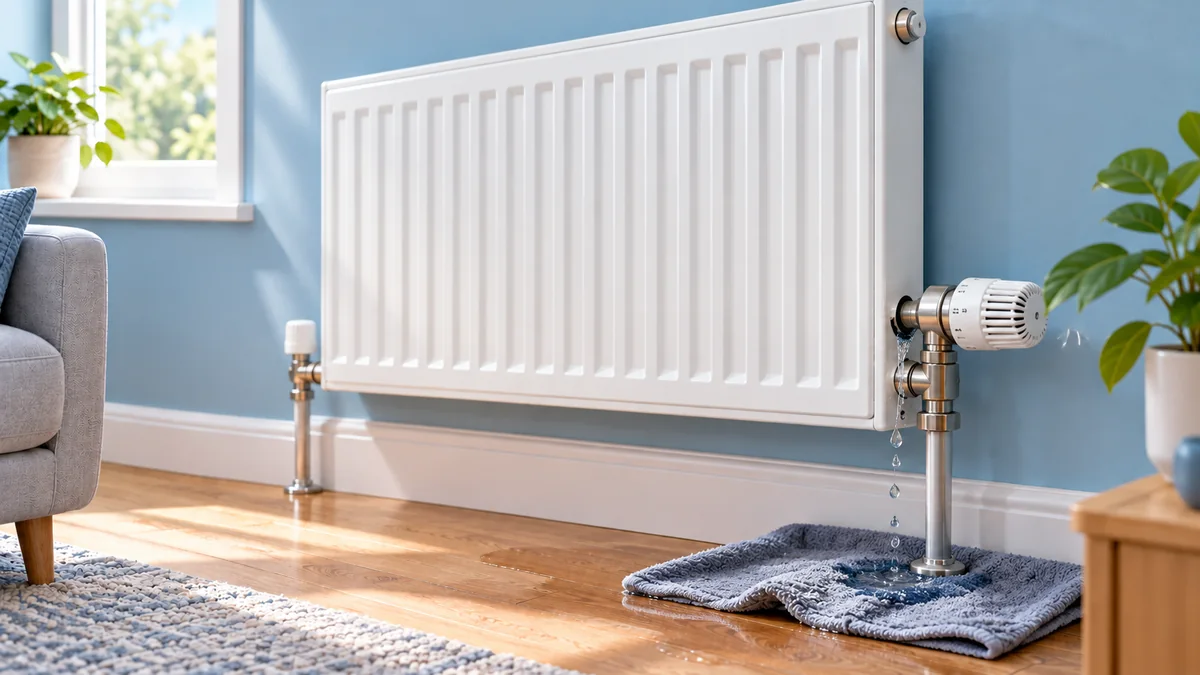
INTERACTIVE LEAK-LOCATION FINDER
Where does the water first appear?
Look for the highest point that becomes wet, not just the puddle beneath it. Water can travel along a radiator seam or down a pipe before it falls. The eight choices below separate common leaks by where they begin and suggest the safest next observation. They cannot establish the condition of an unseen seal.
Select the first wet point for an explanation, a safe observation and the next section to read.
System type matters: This guide primarily describes water-filled (hydronic) central-heating radiators common in the UK. Steam radiators, electric radiators and oil-filled portable heaters require different procedures. Never open a steam vent, electric enclosure, pressurised union or radiator plug to investigate a leak.
FIRST 60 SECONDS
What to do as soon as you find a radiator leak
- Prioritise people and electrics. Keep children and pets away, avoid hot water or steam, and move clear of any wet electrical items or sockets. If electrical equipment is at risk, use a safe remote isolation method if possible; do not touch wet switches or plugs.
- Turn the heating demand off using the ordinary accessible thermostat/controller if safe. A radiator can remain hot for some time, so let it cool before going near fittings.
- Contain the spill. Place a shallow tray or absorbent towels where water is falling, protect flooring and possessions, and check the ceiling or room below. Do not put yourself underneath a potentially unstable radiator.
- Record and report it. Photograph the first wet point and note whether the drip is steady, intermittent or accelerating. In rented/shared accommodation, notify the landlord or building maintenance promptly.
- Get help urgently for a spray, uncontrolled flow, scalding water, water in electrics, a sagging/corroded panel or damage spreading through a ceiling. For a minor drip, arrange timely repair rather than ignoring it.
British Gas recommends switching off the central heating, collecting water and closing the radiator valves where suitable. Its guidance also warns that a thermostatic valve can open automatically in very cold conditions. Follow your boiler and radiator manufacturer's instructions rather than assuming a valve is a secure service isolator.
WHY A LEAK STARTS
Five different seals or surfaces can let heating water escape
On a water-filled radiator, heated water circulates inside a metal panel at a pressure determined by the system. Leaks are more accurately diagnosed by which boundary has failed than by guessing from water colour alone.
- Valve spindle or gland: A moving stem passes through a seal, which can wear or fail, making a drop appear beneath the control head.
- Union or compression joint: Two pieces join at a nut and sealing surface. Poor alignment, a damaged olive or a worn seal can allow seepage.
- Bleed or blanking plug: A removable fitting in the radiator's top or side requires a sound seat, washer or appropriate seal.
- Radiator body or seam: Internal corrosion or physical damage may perforate the metal panel; there is no nut to tighten at a hole in the body.
- Hidden or adjacent pipework: Water from a pipe penetration or connection above can track along the radiator and mimic a panel leak.

IDENTIFY THE FIRST WET POINT
A no-dismantling way to trace a small drip
With the heating off, the radiator cool and water contained, take a photograph before wiping the accessible outside surfaces dry. For a mild stable seep, hold or place a dry tissue near one externally reachable area at a time — the top vent, valve handle/stem, union, lower pipe and panel seam — without touching hot parts or moving electrical cables. Where the tissue first becomes wet is a clue to the source.
Never chase a leak by opening or tightening multiple connections. It is easy to confuse water that has run down a valve with water emerging from the bottom fitting. A damp patch on the floor away from any visible joint may also originate in pipework hidden beneath the floor. If safe observation cannot identify the source, stop and use a plumber's inspection.
| First wet point | Most relevant mechanism | What to do next |
|---|---|---|
| Below the TRV/manual handle | Stem / gland packing | Photograph and have seal/valve assessed |
| Large nut by radiator end | Valve-to-radiator union or tail | Avoid turning nut under pressure |
| Lower pipe at valve/floor | Compression joint or adjacent pipe | Watch for water from higher up |
| Top corner vent | Bleed-screw seat or seal | If recently bled, do not force; seek repair if weeping persists |
| Flat panel or lower seam | Corrosion or split metal | Arrange assessment for radiator replacement |
| Floor from beneath radiator | Hidden pipework, migrating water | Stop guessing; investigate floor/ceiling damage |
LEAK 1 — VALVE HANDLE OR STEM
Why does a radiator drip underneath the thermostat or valve head?
A thermostatic radiator valve (TRV) changes the flow through its valve body, using a small moving pin and stem. A manual wheel valve has a related moving stem. Water escaping around that stem indicates a gland or packing seal problem, not automatically a problem with the removable plastic control head. A drip may become obvious only when the valve position changes or the heating cycles.
If the metal valve body remains wet after the external pipe and radiator union have been dried, ask a heating professional to identify the seal and determine whether the gland can be serviced or the complete valve should be replaced. Taking off a plastic TRV head does not repair the seal. Do not remove packing nuts, pull pins, force stuck valves or use the TRV temperature setting as proof that flow is isolated.
LEAK 2 — BETWEEN RADIATOR AND VALVE
Why is the large connection nut leaking?
The valve connects to the radiator via a tail or union. A union relies on its sealing faces and correct alignment; a nearby compression connection may depend on an olive gripping the pipe. Repeated expansion, disturbed pipework, imperfect assembly or damage can create a slow weep. The visible nut itself is not always the faulty part.
An engineer may check alignment, remake a seal, replace a fitting or make a controlled adjustment after the system is properly isolated and cooled. Do not simply twist a union nut on a hot or pressurised radiator: it can worsen the leak or release the connection completely. PTFE tape applied externally over a nut is not a dependable repair, and tape is not a universal substitute for a failed metal-to-metal union seat.
LEAK 3 — PIPE OR FLOOR CONNECTION
Why is water appearing at the pipe beneath the radiator?
A vertical feed or return pipe typically enters a valve close to floor level. Water may be escaping from a compression joint there, dripping from the higher valve stem and travelling down the pipe, or rising/collecting from damaged hidden pipework. That last possibility matters particularly when the first sign is a stain on the ceiling downstairs.
Use only exterior observations to find the highest wet point. If the leak disappears behind plaster or beneath flooring, note any cold/wet patch, inspect nearby accessible ceilings, contain water and contact a plumber or leak-detection specialist. Do not cut floors, undo valve unions or assume the entire central-heating circuit has drained because its boiler has been switched off.
LEAK 4 — TOP BLEED VENT
Why is the radiator leaking after bleeding?
A manual bleed point usually uses a small square-ended screw that controls a vent passage. If it has not reseated, its washer is worn or the thread/seat is damaged, the top corner can weep. This is especially easy to notice just after bleeding a radiator.
If the manufacturer instructs the user to close the vent after bleeding, confirm that it is in its ordinary closed position once cool; do not force the screw tighter or remove it. Continued leaking calls for professional replacement or repair of the appropriate vent assembly after safe isolation and depressurisation. A round fitting beside it may be a blanking plug, not a bleed screw. Don't mistake the two.
LEAK 5 — BLANKING PLUG
Why is water coming from a capped radiator opening?
Some radiator ports are closed with larger threaded blanking plugs. Their seal can be damaged or badly seated. If the surrounding panel is sound, the plug or seal may be serviceable; however, the repair involves a pressure-containing connection, so it is not the same as turning an external thermostat dial. Ask a competent installer to isolate and repair the fitting safely. Never remove a plug to see whether water is behind it.
LEAK 6 — RADIATOR BODY OR LOWER SEAM
Does a rust stain or pinhole mean the radiator needs replacing?
Steel panel radiators rely on intact metal to keep the heating water in. Internal corrosion can gradually thin the steel, sometimes causing a fine jet, a brown tear-shaped stain, a wet weld or a pinhole near the bottom. External mechanical damage can also split a seam. Corrosion is influenced by oxygen ingress, water chemistry, protection and system condition; black radiator water alone does not prove why a particular hole formed.
A confirmed leak through the panel generally means the radiator should be replaced, not merely tightened or repeatedly sealed. System-water testing and checking inhibitor protection may be appropriate to reduce further corrosion. A power flush is not an automatic cure for an already perforated radiator and can be unsuitable for weakened components. Temporary leak-sealing additives should only be considered with system-manufacturer and competent-professional guidance, not as a permanent panel repair.
THE WIDER CENTRAL-HEATING CIRCUIT
How are radiator leaks and boiler pressure connected?
A sealed wet-heating system has a pressure gauge. When water escapes, its cold pressure may fall; a major leak can lead to heating shutdown or an error message. Small losses may take time to become visible on the gauge, and a steady reading does not rule out a small leak. A rising pressure problem may instead involve an expansion vessel or pressure-relief valve fault, so avoid assuming high pressure caused a particular radiator joint to fail.
Compare pressure only against your own boiler manual and when it is safe to view. Repeatedly topping up a leaking system can hide the fault, introduce fresh oxygen and prolong water damage. Worcester Bosch specifically advises checking visible valves/connections, possible underfloor leaks and the external pressure-relief discharge when pressure keeps falling. See our boiler losing pressure guide.

US STEAM RADIATORS
What if an American steam radiator is leaking or hissing?
A steam radiator is not a UK-style water-filled panel radiator. Steam enters, condenses and must return via the proper piping. Steam can escape at a faulty air vent, valve stem or threaded joint, and condensate can leak from those places. A whistling or spitting vent may not be closing as designed; a dripping supply valve can have failed packing. US hydronic baseboards, steam radiators and electric wall heaters are three different appliances.
Do not bleed steam radiators as if they held circulating hot water. Do not loosen a hot air vent, lift a radiator, repack a live valve or interfere with the steam boiler. Steam burns can be severe. Turn down the heating if safe, keep clear of the leak and find a contractor familiar with your system type. This Old House explains common steam vent and valve failure mechanisms.
RELATED TROUBLESHOOTING
Other symptoms that help narrow the problem
These existing Clear Simple Answers guides complement the leak-location checks. A heating problem and a leak can happen together, but neither proves the other caused it.
COMMON QUESTIONS
Frequently asked questions
Is a tiny drip from a radiator serious?
Even a slow leak can damage flooring and eventually reduce heating-circuit pressure. Contain it and organise a timely repair. A spray, hot discharge, active electrical hazard or rapidly spreading water calls for urgent help.
How do I tell whether the valve or radiator itself is leaking?
On a cool radiator, identify the highest external point becoming wet after carefully drying accessible surfaces. A drip from a valve can track onto the panel; water forming directly on an intact-looking panel seam or rust hole raises concern for corrosion.
Can I use the thermostatic radiator valve to stop a leak?
Turning it to a lower temperature does not guarantee isolation. Some TRVs have a frost-protection response and may reopen. If the leak is significant, contact a plumber; never dismantle a connection on the assumption that the TRV is closed.
Why is my radiator leaking when the heating is off?
A sealed heating circuit may still contain pressurised water when its pump and boiler are off. A worn connection can continue to drip from that static pressure or from water remaining inside an isolated radiator.
Can I simply tighten a radiator union nut?
Do not assume the joint is loose. A damaged sealing face, misalignment or worn olive may be responsible, and turning a hot pressurised union risks a much larger leak. Have it assessed and safely isolated for repair.
Why did the leak start after bleeding a radiator?
A vent screw may not have seated fully, or its washer/seat may be worn. Check only the maker's ordinary closed position after the radiator cools, without forcing or removing the vent screw. Persistent seepage needs repair.
Does brown water mean radiator sludge caused the leak?
Discolouration can indicate corrosion products, but it does not identify the exact route of failure. A corroded radiator may need replacing; any wider system-treatment decision should follow inspection or testing.
Will leak-sealing fluid permanently fix a pinhole in the radiator?
Do not rely on it as a permanent repair for perforated steel. Additives may be inappropriate for some boilers and components. Replacement of the damaged radiator, with assessment of system-water protection, is usually the robust solution.
Can a leak make my boiler lose pressure?
Yes. Water escaping from a sealed system can reduce pressure and eventually cause a fault or shutdown. Slow leaks may not produce an immediate gauge change, so look for stains and inspect visible connections safely.
Should I keep topping up my boiler until the plumber arrives?
Do not repeatedly refill a system that you know is leaking simply to keep it running. Follow the boiler's instructions and contact a heating professional; recurring refills can mask the leak and introduce oxygen into the circuit.
Will turning off my mains water supply stop a radiator leak?
Not necessarily. Some wet-heating systems have their own sealed circuit and contain water under pressure even with the mains isolated. System arrangements differ. Seek type-specific advice; do not assume the leak is stopped.
How is a leaking US steam radiator different?
It may leak condensate or vent steam at a failed air vent, stem or fitting. Steam can cause severe burns and its fittings differ from hot-water radiators. Turn heating demand off if safe and call a steam-experienced contractor rather than using a standard radiator bleeding procedure.
AUTHORITATIVE REFERENCES
Manufacturer and technical guidance
References used to check the mechanisms and safe-first response. Follow your own equipment manual; advice differs for sealed hydronic, open-vented and steam systems.
- British Gas — Radiator issues, leak containment and TRV warnings
- Worcester Bosch — How to investigate persistent heating-system pressure loss
- Screwfix — Radiator valve, bleed-point, connection and body leaks
- Checkatrade — Leak-source identification and repair considerations
- This Old House — Leaking and whistling US steam radiators
- This Old House — Steam boiler, radiator and condensate leaks