START WITH THE SYMPTOM
Which fridge problem matches yours?
Take a temperature reading from the middle of the fridge, away from the door, after the thermometer has stabilised. Check whether the freezer is still maintaining its usual temperature. Feel and sound are clues, not substitutes for a thermometer: a fridge light can work while its cooling system is disabled.
Select a symptom to get the most useful safe first check.
| What you notice | Possible explanation | First useful check |
|---|---|---|
| Fridge warm, freezer cold | Airflow, fan or frost problem in certain combined designs | Look for blocked vents and ice |
| Both compartments warm | Door left open, wrong setting, ventilation or cooling failure | Check power, controls and seals |
| Lights or display off | No external power or an electrical fault | Verify safe accessible socket |
| Lights on, no cooling | Demo mode, control or cooling-system fault | Check temperature and mode |
| Visible frost around vents | Air leak or defrost/circulation issue | Inspect gaskets, vents and repeat frost |
| Newly installed fridge | Temperature still stabilising | Follow manufacturer's setup window |
| Frequent clicks, warm cabinet | Heat rejection, starting or compressor trouble | Check external ventilation; seek repair |
UNDERSTAND THE MECHANISM
How a fridge removes heat — and where cooling can fail
A refrigerator doesn't create cold; it moves heat from its interior to the room. Refrigerant evaporates inside a sealed cooling circuit, absorbing heat, while the compressor circulates it and the condenser releases heat outside. Fans and air passages distribute cooled air on many models. Controls switch the system on and off to maintain the set temperature.
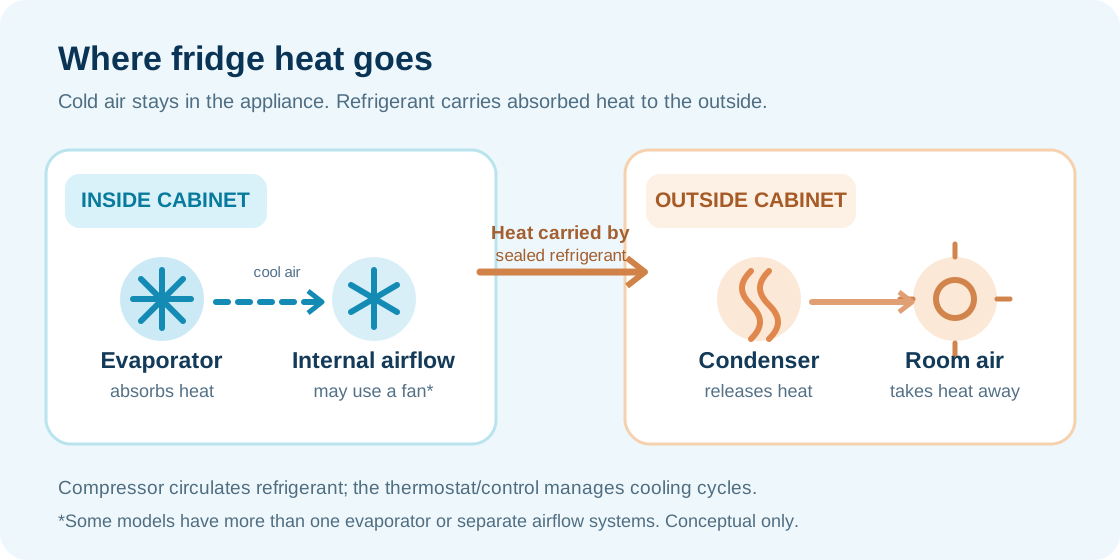
If the freezer is cold but the fridge is warm, cooling may be happening but distribution can be restricted. If both are warm, investigate power, settings, doors and whether the refrigeration circuit can move heat. Different manufacturers arrange evaporators, condensers and fans differently; this pattern is not a definitive parts diagnosis.
DON'T WAIT FOR THE REPAIR
1. Check the temperature and protect perishable food
Place a suitable independent thermometer on a middle shelf. A dial marked 1–5 or 1–7 may show a relative cooling setting, not degrees Celsius. The UK Food Standards Agency recommends keeping the fridge between 0°C and 5°C; aim around 3–4°C for a useful margin. US federal guidance uses 40°F / 4°C or below. The freezer target is commonly −18°C / 0°F.
If the fridge is warm, prioritise food before attempting to fix it. Keep the door closed as much as possible and move perishables to working cold storage where available. Record roughly when the problem began. US FoodSafety.gov says a closed, unpowered fridge generally protects food for about four hours; discard refrigerated perishables after four hours without power, and discard perishable food kept above 40°F (4°C) for two hours or longer. Other circumstances and UK food-safety decisions require judgment based on duration, product and temperature. If uncertain, do not risk eating perishable food.
Do not use smell or taste to decide if food exposed to unsafe temperatures is edible. See official FSA fridge temperature advice and US food safety during refrigeration failures.
FRIDGE WARM • FREEZER STILL COLD
2. Look for blocked vents, frost or a failed air-circulation system
In many single-evaporator fridge-freezers, the freezer provides a source of cold air and an internal fan moves some of it to the fresh-food section. If a packet blocks an opening, a damper remains shut or the fan is obstructed by ice, the freezer may stay frozen while the fridge warms. This is not universal; some newer models have separate cooling circuits.
Look for food pushed hard against marked air outlets on the interior wall. Reposition containers without crowding the shelves. If you can see thick ice near a vent, note whether it returns after normal use. Recurrent heavy frost, odd fan noises or no cooling despite clear vents suggests a fan, damper or defrost problem requiring service. Never remove freezer panels, chip ice with a tool or use a heat gun/hairdryer inside the appliance.
Do not deliberately prop the freezer door open as a test. Some fans stop automatically when a door is opened, so silence in that moment is not proof the motor has failed.
POWER & SETTINGS
3. Verify the controls, socket and demo mode
Ensure the appliance is plugged into a safe, suitable outlet, the wall switch is on where relevant and the digital temperature setting is correct. If the interior light and display are both dark, check an accessible, dry socket with a known-working device of suitable rating. Avoid extensions, damaged plugs and moving a heavy fridge alone to reach a hidden socket.
If the lights work but cooling does not, check for Demo, Showroom, Cooling Off or OF OF indicators. Such modes can operate the lights or display without running the cooling system. Samsung documents this pattern, though disabling it differs by model; consult your appliance manual rather than entering random key combinations. The set temperature also needs time to stabilise after a change, so do not continuously lower the dial.
After moving a refrigerator, follow the maker's instructions for how long it should stand before being powered on; the time depends on transport orientation and design. A newly installed or heavily loaded appliance may need several hours, sometimes a day, to reach a stable reading. Do not put food at risk while waiting for an obviously malfunctioning fridge.
HEAT GETTING IN
4. Check the door gasket and how the fridge is loaded
Look for a door shelf, bottle, drawer or misaligned container that prevents full closure. Wipe sticky debris from the rubber gasket with a damp cloth and mild detergent, then dry it. Check for tears, flattened sections or gaps around the perimeter. Condensation near a seal or frost around the door can suggest warm humid air is getting in.
Keep shelves organised with space around the model's air outlets. Overloading can restrict circulation, but a nearly empty fridge can also behave differently after repeated openings; the correct check is temperature over time with the door closed. If the door hangs unevenly or the cabinet wobbles, use the model's setup instructions for positioning and levelling. Don't pull a heavy appliance forward unsupported or alter built-in hinges without guidance.
Nearby ovens, radiators, direct sunlight and inadequate external clearance can make it harder for a fridge to release heat. Use the manufacturer-specified gap rather than assuming every fridge needs the same clearance—some built-ins are designed for a ventilated enclosure.
HEAT CANNOT ESCAPE
5. Inspect only accessible external vents and condenser dust
A cooling system must release absorbed heat to its surroundings. On some models, dust and pet hair clog externally accessible condenser grilles or rear coils. With power safely disconnected, remove visible dust using a soft brush or vacuum only where the owner's manual allows. Do not detach service covers, expose wiring or touch moving fan blades. Many modern fridges have hidden or built-in condenser surfaces that are not designed to be user-cleaned.
If the compressor appears to click repeatedly, the outside becomes abnormally hot, a burning smell develops, or cooling stays poor after normal external checks, stop troubleshooting and arrange service. A failed starting component, fan, sensor or refrigeration system can produce similar signs, and a technician must confirm which is responsible.
PERSISTENT COOLING FAILURE
6. When to call an appliance engineer
Arrange a professional diagnosis if both sections remain warm with settings and door closure correct; if there is repeated ice buildup behind panels; if an unusual fan noise persists; or if clicking and compressor cycling continue without cooling. A sealed refrigerant-system fault or compressor failure requires specialist tools and, where applicable, appropriately qualified engineers. Don't pierce tubing, add refrigerant or remove internal electrical panels.
Before calling, note the make and model, displayed error codes, measured fridge and freezer temperatures, the age of the appliance and whether cooling changed suddenly or gradually. This helps the engineer distinguish a control or fan problem from a sealed-system issue. For older appliances, compare warranty coverage and a written repair estimate with the cost of replacement.
If the symptom is mainly a loud hum or buzz, read why the fridge is buzzing. If water has pooled inside or underneath, see fridge leaking water. For a freezer that's also failing, the freezer not freezing guide deals with that specific pattern.
SAFE FIRST STEPS
Five checks in the right order
- Protect the food. Confirm the internal temperature and move at-risk perishables to safe cold storage.
- Compare compartments. Is the freezer holding temperature, or are both sections warm?
- Check settings and doors. Verify the control setting, cooling mode, door seals and any obstructing food.
- Clear accessible vents. Leave room around internal outlets and confirm the specified exterior ventilation.
- Allow an appropriate recovery period, then reassess. If safe checks make no difference, record temperatures and arrange service.
Thermometer reading, door closure, visible air outlets, temperature settings, demo mode and accessible external dust as permitted by the manual.
Internal fans behind panels, electrical controls, compressor starting components, defrost heaters, refrigerant pipework and sealed-system repairs.
COMMON QUESTIONS
Frequently asked questions
Why is the freezer cold but the fridge warm?
On some combined models, frozen air is not reaching the fridge because of obstructed vents, ice buildup, a fan issue or a damper fault. Other models have independent cooling systems. Clear visible obstructions, record frost and consult the model manual if the problem continues.
What temperature should a fridge be in the UK?
The UK Food Standards Agency recommends a fridge at 5°C or below, ideally within 0–5°C. A setting of around 3–4°C offers some room for routine variation, but confirm it with a thermometer.
Why is the fridge light on but it isn't cooling?
Lights and displays can operate even when the cooling system is off or faulty. Check for Demo/Cooling Off modes and the set temperature. A failed fan, compressor start component or another fault can also leave the lamp working.
Can a fridge take 24 hours to get cold?
Some manufacturers advise allowing up to 24 hours after installation, large grocery loads or setting changes for full temperature stabilisation. Always follow your model's manual, and do not store perishable food at unsafe temperatures while waiting.
Should I turn the fridge thermostat to maximum cold?
Not immediately. Verify what the dial numbers actually mean and measure the temperature first. Changing controls repeatedly makes diagnosis harder and may cause freezing in areas that are still cooling.
Does a warm fridge always mean a bad compressor?
No. Door gaps, blocked vents, wrong settings, demo mode, dusty external grilles and fan or defrost faults can mimic major refrigeration failure. A compressor or sealed-system fault must be confirmed by a qualified technician.
REFERENCES & RELATED GUIDES
Official guidance and further reading
Manufacturer layouts and allowed cleaning procedures vary. Follow your exact model's handbook for clearance, modes, maintenance and temperature recovery times.