INTERACTIVE HIGH-PRESSURE FINDER
What happens to the pressure?
Start with the pattern and timing. The pressure gauge on a typical sealed gas central-heating system measures water in the radiator circuit, not pressure at your hot tap. A reading taken just after heating is not directly comparable with one taken after several hours of cooling.
| Reading pattern | Possible mechanism | Next step |
|---|---|---|
| High immediately after filling | Too much water admitted | Confirm the filling controls are shut; allow to cool |
| Rises even while cool | Filling control passing water or system-specific fault | Arrange inspection; do not repeatedly drain |
| Normal cold, unusually high hot | Expansion not being accommodated | Record two readings and contact a qualified engineer |
| Relief outlet drips | PRV may have opened or not reseated | Do not cap, test or operate the valve |
| Gas or CO warning | Separate urgent safety issue | Follow emergency procedure and avoid boiler DIY |
THE MECHANISM
What makes boiler pressure rise?
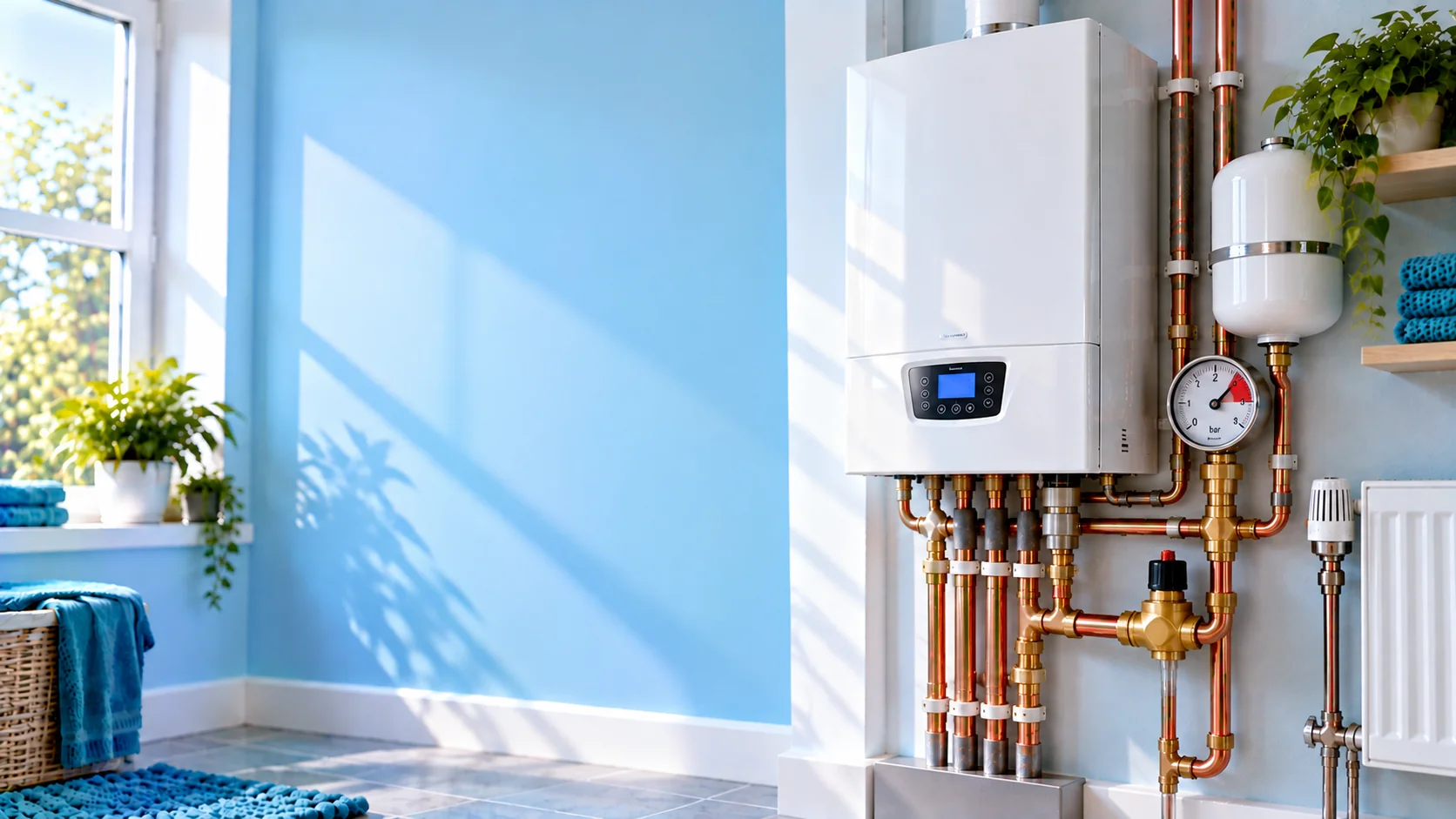
Many modern UK combi and system boilers use a sealed heating circuit: the same water circulates around radiators, pipes and a heat exchanger. When this water is heated, it expands. Because the circuit is closed, an expansion vessel with a flexible diaphragm and compressed gas cushion accommodates the increase in volume. Without enough expansion capacity, pressure climbs much more dramatically.
Two other processes can increase the reading even when the heating is off. Somebody may have added too much water through a filling loop, or a faulty filling valve may allow mains water to creep into the sealed circuit after it should have been closed. A pressure-relief valve (PRV) is a safety device designed to discharge water above its rated threshold, often around 3 bar on UK domestic sealed systems. It is not a routine pressure-adjustment control.
That is why the timeline matters more than one number: high after filling, creeping up while cold and shooting up only while hot point to different mechanisms, even if they produce the same gauge reading.

Technical note: these patterns help identify the next inspection; they do not prove a particular component has failed. A heating engineer may need to test the expansion vessel's air charge, the filling valve and the PRV separately.
SAFETY FIRST
When should you stop using the boiler?
If you smell gas, leave the building and use the appropriate gas emergency procedure; in Great Britain call the National Gas Emergency Service on 0800 111 999. If a carbon monoxide alarm sounds or you suspect CO exposure, get into fresh air and seek emergency assistance. Do not return until advised it is safe. For gas appliances, use a Gas Safe registered professional in Great Britain; elsewhere use a suitably licensed heating professional.
A wet cable, breaker, socket or boiler control introduces electrical risk as well as water damage. Do not touch wet electrical equipment. High pressure is not a reason to open the boiler cover, adjust combustion settings or manipulate any internal valve.
READ THE GAUGE CORRECTLY
What pressure is too high?
Many UK sealed heating systems operate around 1–1.5 bar when cool, with a moderate rise while heating. Vaillant notes that the typical operating range depends on the model; Worcester Bosch describes a rise of more than roughly 1 bar from cold to hot as a reason to investigate expansion capacity. Some UK systems have a relief setting close to 3 bar, but none of these figures replaces your boiler manual.
Readings can differ in taller properties, systems with larger water volumes and non-UK hydronic installations. A warm boiler may show around 2 bar without having a fault. In contrast, a system that moves from 1.2 bar cold to almost 3 bar hot, then drips outside, needs qualified assessment even if the cold reading later looks normal.
- Find the heating pressure gauge or front-panel reading identified in the user manual.
- Record the pressure once the system is cool and has been off long enough to settle.
- Only if it is safely operating normally, note the pressure during an ordinary heating cycle; do not run it merely to reproduce a dangerous spike.
- Compare the readings with your model's stated range, and note any error code or outside discharge.
Make a short log of the date, cold reading, hot reading and any filling or radiator bleeding. A photograph of the gauge may help an engineer, but do not remove any covers to take it.
CAUSE ONE
The system was overfilled
After a boiler has been repressurised, a homeowner may accidentally leave the filling controls open too long. The extra water raises the system pressure immediately—even before the heating runs. In that situation the starting pressure is already too high, so a normal rise with heat may push it towards the PRV threshold.
If you have just topped up the boiler, check from the outside that the filling loop's user-operable valve or valves have been returned to their fully closed position in accordance with the exact boiler manual. Do not assume a blue or black handle is always the filling valve; layouts differ. Let the system cool before deciding whether the pressure remains elevated.
Some manufacturers describe releasing small amounts of water through a radiator as a correction for accidental overfilling. This can involve hot, pressurised water and the risk of scalding or damaging the system. Follow your model-specific instructions only if competent and conditions are safe; otherwise ask an engineer to bring the pressure back to its specified range. Do not use the boiler's safety PRV as a drain valve.
CAUSE TWO
The filling valve may be letting in water
If the pressure rises slowly while the heating remains off and cool, thermal expansion cannot explain the change. On a sealed system, a filling valve that does not seal properly can pass mains water into the heating circuit. An external filling loop left open can cause the same effect.
Record whether the reading creeps upward overnight without any heating demand. From the outside, identify the filling controls using the manual and confirm any user-accessible control is closed. Do not dismantle the loop, attempt to service its check valves or turn unfamiliar isolators. If the reading still climbs, arrange qualified testing.
On some boiler or cylinder configurations, a heat exchanger or other cross-connection fault can also introduce higher-pressure water to the heating side. This is less straightforward to confirm from outside the appliance and should be investigated by a qualified engineer, not diagnosed by guessing at an expensive part.
CAUSE THREE
The expansion vessel cannot absorb the rise
Inside an expansion vessel, a flexible diaphragm separates heating water from a gas cushion. The water pushes into the vessel as it expands, compressing the gas and preventing a large pressure jump. If the gas charge is lost, the diaphragm fails or the vessel is undersized for the system, too little expansion volume remains.
The telltale pattern is a reasonable cold reading followed by an unusually large hot-pressure increase. The PRV may then discharge water. After cooling, pressure can fall below the starting value because some water has left the circuit. That creates an apparently contradictory combination of high pressure while hot and low pressure when cold.
An engineer can safely depressurise and test the vessel, assess its sizing and check the relief valve. Do not press the expansion vessel's air valve, inject air, disconnect it or open the boiler casing. These operations require knowledge of the system's temperature, pressure and safe isolation procedure.
CAUSE FOUR
Water is coming out of the relief pipe
The pressure-relief valve is a safety component. When system pressure exceeds its design threshold, it may open to release water through a discharge route. The visible outlet may be a copper pipe outside, although exact arrangements vary by installation and country. Water there suggests the system has become overpressurised or the valve is not sealing correctly.
Look only from a safe place. A discharge may be very hot; keep children and pets clear and do not touch it. Never cap, redirect into a closed container, seal or operate the relief valve as an improvised way to lower pressure. Repeated discharge needs an engineer to diagnose the underlying cause and inspect the valve itself.
In a condensing boiler, do not confuse a clear, cold-water-like condensate drain with a safety relief pipe. The condensate line normally carries water formed during efficient combustion. An engineer can identify the correct discharge path from the installation. If the pressure is low after a hot-pressure spike, read why a boiler loses pressure for the related mechanism.
FIVE SAFE EXTERNAL CHECKS
What can you check without opening the boiler?
- Check the manual: confirm the model's normal cold operating range and high-pressure warning level.
- Record cold pressure: take a reading when the boiler has cooled; distinguish a persistent problem from a temporary warm reading.
- Review the filling loop: if you recently added water, make sure the model's user-accessible filling controls are shut.
- Check for outside discharge: from a safe distance, note whether the relief outlet is dripping or wet. Do not touch it.
- Note fault codes and timing: record whether the rise happens while heating, while idle, after radiator work or after refilling.
You do not need to open the casing, adjust internal pressure components or deliberately heat the boiler to collect useful information. Your observations help a registered heating engineer prioritise the relevant tests.
MATCH THE REPAIR TO THE CAUSE
What actually fixes excessively high pressure?
Accidental overfill: bring the cold system back to the manufacturer-specified pressure using a documented safe procedure or professional assistance. Prevent recurrence by closing filling controls properly after topping up.
Filling-control fault: have the leaking valve or filling assembly inspected and repaired. Repeatedly draining water without fixing the incoming path will not solve the problem.
Expansion-vessel fault: an engineer assesses the charge, diaphragm, vessel capacity and condition of the PRV. If a PRV has discharged, it may also need servicing or replacement even once the expansion issue is corrected.
Pressure-sensor or gauge problem: if the reading behaves implausibly, a professional can compare it with independent measurements. A faulty gauge should not be assumed until the system is safely checked.
Do not use a radiator bleed key, filling loop, relief valve or drain-off as an ongoing pressure regulator. If the boiler keeps rising towards its limit, stop the heating and seek a qualified repair.
UK AND US SYSTEMS
Does this apply to US boilers?
The underlying physics of a sealed hydronic heating circuit are similar in the UK and United States, but the operating pressure, expansion-tank type, pressure reducing/fill valve and relief-valve specification can differ. Some US homes have dedicated domestic water heaters separate from the space-heating boiler. Do not apply a UK combi boiler's 1–1.5 bar target to a different system without checking its documents and a licensed professional.
Open-vented UK heating systems also behave differently because they can use a feed-and-expansion cistern rather than a sealed, pressurised circuit with a front-panel gauge. This guide primarily applies to boilers that have a sealed heating pressure reading. If your installation has no comparable gauge, follow the correct system-specific guidance instead.
FREQUENTLY ASKED QUESTIONS
Boiler high-pressure FAQs
Is 2 bar too high for a boiler?
Not necessarily. A warm sealed system may rise to around 2 bar. Compare it with a cold reading and your exact manufacturer's normal range.
Why does boiler pressure climb towards 3 bar?
An overfilled system, a passing filling valve or inadequate expansion capacity can cause the pressure to approach the relief-valve threshold. Stop the heating safely and arrange inspection.
Why is pressure normal cold but too high with the heating on?
Heated water expands; an excessive hot-pressure increase can indicate an expansion vessel that is not accommodating this volume properly.
Can the filling loop raise pressure when the boiler is off?
Yes. A filling loop left open or a valve that leaks internally may continue introducing mains water into a sealed heating circuit.
Why does the pressure drop after being high?
A hot-pressure spike can open the PRV and discharge water. When the remaining water cools, the gauge may then read low.
Should I bleed a radiator to lower pressure?
Some manufacturers allow careful correction of accidental overfill on a cooled system. Because escaping water can scald or damage property, follow model-specific instructions only if competent; otherwise get professional help. Never use the PRV for this.
Can I open the pressure-relief valve myself?
No. Do not operate it simply to release excess pressure. It is a safety component and can fail to reseal, discharge hot water or conceal a serious fault.
Why is my pressure relief pipe dripping?
It may have discharged due to high pressure or the valve may not be sealing. The outlet must remain unobstructed; a qualified professional should inspect the cause.
Does high boiler pressure make my shower powerful?
No. The heating pressure gauge normally measures the sealed radiator circuit, not the domestic hot and cold tap supply pressure.
How much does pressure normally rise during heating?
A moderate increase is expected. Worcester Bosch says a rise greater than about 1 bar from cold to hot can indicate an expansion-vessel problem. Always use your model's limits.
What if the pressure is high even though the heating is off?
Confirm the system really is cool and check filling controls from outside. If pressure continues to rise, arrange an engineer to identify the source.
Do US boiler pressures use the same limits?
Not always. US hydronic and domestic hot-water equipment have different design pressures and safety devices; follow the exact unit manual and use a licensed heating professional.
AUTHORITATIVE SOURCES
Manufacturer and safety references
These sources explain typical operating pressures, pressure-relief devices and reasons for unusually high readings. Always defer to the exact boiler model's user instructions.