START WITH THE CLUE
What kind of toilet smell are you noticing?
A toilet odour is a location problem as much as a cleaning problem. First ask whether it smells like urine, sewage, dampness or cleaning chemicals. Then notice whether it happens only after a flush, only in an unused bathroom, or even when the toilet is untouched. Odour alone cannot prove which part has failed, but its pattern helps you avoid the wrong repair.
Choose a symptom to see what to inspect first.
| Odour and timing | What to check first | Why it helps |
|---|---|---|
| Urine smell returns after cleaning | Seat hinges, underside of rim, grout and floor beside pan | Residue may sit outside the visible bowl |
| Sewer smell and low bowl water | Bowl water seal, refill behaviour, other fixtures | Less standing water can weaken the gas barrier |
| Smell after a flush or shower | Drainage noises, slow fixtures, accessible waste connections | Pressure change or a leaking joint may expose sewer air |
| Mustiness with wet or soft floor | External moisture, leaks, hidden damp | Cleaning alone cannot fix a water source |
THE MECHANISM
Three ways odour gets into a bathroom
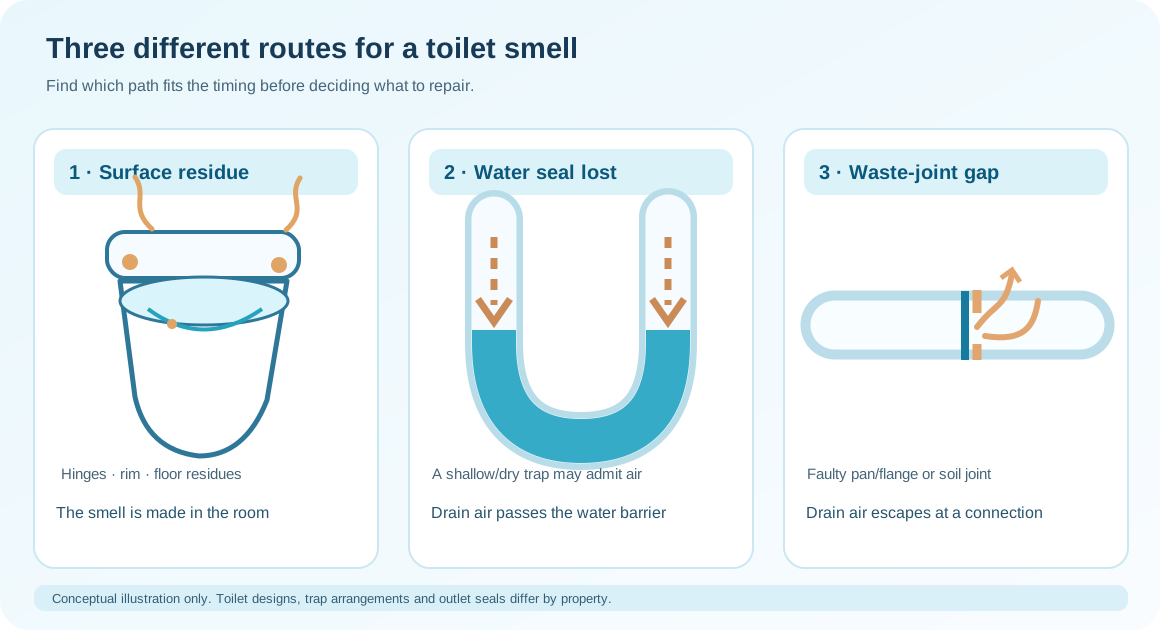
It helps to separate odour being produced on a surface from odour travelling from wastewater plumbing. Ordinary use leaves small residues on exposed surfaces. In contrast, plumbing is designed to keep drain air separated from the room by standing water in traps and sound, airtight waste connections.
1. Residue produces odour in the room
Small splashes can reach hinges, bolt caps, the underside of the bowl rim, the back of the pan and the floor. Bacteria acting on residue can produce an ammonia-like smell. This can return quickly after cleaning the visible bowl because the source is elsewhere.
2. A water-filled trap normally blocks drain air
The visible standing water inside the toilet is part of the water seal in its integral trap. Nearby basins, showers and floor drains have their own traps. If a water seal becomes too shallow or disappears, drain odours can pass into the bathroom. Important distinction: an unused shower or floor drain is often a more likely dried-out trap than a normally functioning toilet bowl with its usual water level.
3. A waste connection can leak gas without a puddle
UK toilets commonly use rubber-sealed pan connectors to the soil pipe. Many US floor-outlet toilets sit on a wax or wax-free flange seal. Either arrangement can develop a defect, allowing sewer air to escape without leaving obvious liquid on the floor. A rocking pan, recent toilet work or a smell concentrated at a connection makes an inspection sensible, but does not prove the seal has failed.
Drain restrictions, blocked ventilation or faulty air-admittance arrangements can also change pipe pressure and disturb water seals. These are system-level diagnoses, not good reasons to dismantle a toilet immediately.
URINE OR STALE ODOUR
The toilet looks clean. Why does it still smell of urine?
Start with the surfaces a normal bowl clean misses. Inspect the underside of the toilet seat, the hinge mounts and plastic covers, underneath a traditional flush rim, the exterior back of the pan, grout and the edges where flooring meets the base. Strongly scented cleaners can temporarily hide residue without removing it.
Safe cleaning sequence: open ventilation, put on gloves, and use one manufacturer-approved household cleaner at a time. If the seat has a documented quick-release mechanism, remove it in accordance with instructions, clean the exposed hinge area and dry it fully. Do not force fittings or remove the entire toilet to investigate a smell. For stubborn deposits, use a suitable labelled product for that specific surface; test porous grout or sensitive finishes as directed.
Under-rim limescale can trap dirt in rimmed toilets. Geberit advises cleaning this area and the surfaces around the toilet. Follow product instructions carefully and do not combine descalers, vinegar, acidic toilet gel, bleach or other chemical products. If you have already used one product, do not immediately follow with another.
THE WATER SEAL
Why a low bowl water level can allow sewer odour
A healthy toilet generally holds a repeatable resting level of water in its bowl. That water creates a physical seal within the trap. If the bowl ends a flush unusually low, first determine whether it was under-refilled rather than assuming the drain has a hole. Refill-hose or flush-mechanism arrangements differ between common US tank toilets and UK flush-valve toilets.
If water starts at a normal level and drops later, pressure effects, a partial blockage or a defect can be possibilities; the pattern matters more than a single measurement. Do not pour large quantities of water into a toilet that is slow, blocked or approaching overflow. Instead, follow the low toilet water level guide.
A rarely used shower, bath or floor drain nearby can also lose its trap water over time. If there is no backup or blockage warning, run a normal amount of water through that particular unused fixture to replenish its trap and observe whether the bathroom smell improves. This does not fix a defective toilet joint or a drain that repeatedly siphons water away.
SEWER ODOUR AFTER FLUSHING
Why does the smell appear when I flush?
A flush sends wastewater through a network that must also move air. If downstream flow is restricted, pressure can change in branches and traps; an open or poorly sealed connection can then admit a smell. Gurgling, bubbling, slow draining and a changing water level are useful associated clues, but none by itself proves a blocked roof vent.
Look for visible problems without dismantling the system. Are the basin and shower draining normally? Does the toilet gurgle when the bath empties? Is an accessible waste connector displaced? Was recent plumbing work completed? If two or more fixtures are affected, consider a shared drain or soil-pipe fault and arrange professional assessment. Read the specific gurgling and bubbling guides.
A professional may inspect the drain layout, waste seals, soil-pipe ventilation or air-admittance valves and, where appropriate, use CCTV or smoke testing. Do not climb onto a roof to clear a vent. Do not use caulk, duct tape or chemicals to disguise an unidentified gas leak.
SMELL NEAR THE FLOOR
What if it smells strongest around the toilet base?
Smell at floor height has two very different explanations. Old urine or cleaning residue may collect in seat-bolt covers, grout and floor seams; a waste connection may also be allowing foul air into the room. Check for movement, staining, dampness or a smell concentrated at the rear connector, but do not loosen fittings or lift the toilet.
UK pan connectors commonly seal to a horizontal or rearward soil-pipe opening with elastomeric rings. US toilets frequently use a flange and wax or wax-free seal beneath a floor outlet. Not every toilet has a US-style wax ring. Repairs must match the actual arrangement and manufacturer instructions. Avoid indiscriminate silicone on the floor edge: sealant does not renew a defective waste joint and may conceal escaped water.
If the pan rocks, the floor feels soft or a flush produces dampness, stop using the fixture until it can be inspected. The accompanying toilet base leak guide explains how water can originate above the floor line.
MUSTY OR EARTHY SMELL
When the smell comes from moisture, not the drain
A musty smell can be associated with damp, mould or trapped moisture behind boxing, flooring, the cistern or adjacent furniture. Inspect accessible dry surfaces for condensation, darkened grout, staining, soft flooring or repeated wetness. Improve normal ventilation but do not disturb unknown concealed fittings.
The key is to locate and correct the water source before cosmetic repairs. If flooring is damaged or a ceiling beneath is stained, professional assessment may be needed even when no active drip is visible. A loose pan or softened floor should not be covered by fresh sealant as a substitute for investigating moisture.
SAFEST ORDER OF CHECKS
A practical five-step way to narrow the cause
- Check danger signs before cleaning: wastewater backing up, more than one slow drain, a rising bowl or sewage on the floor means stop using affected fixtures. Arrange drainage assistance.
- Classify the smell: note urine-like versus sewer-like versus musty, where it is strongest, and whether it appears after a flush, shower or several days unused.
- Inspect accessible surfaces: rim, seat hinges, rear of pan, grout and floor. Clean with one compatible product according to its label, and ventilate.
- Observe water and drainage: compare the toilet bowl's usual resting water level, and note whether nearby fixtures drain and sound normal. Only replenish a little-used drain trap if its drainage appears normal.
- Escalate if it persists: repeated sewer smell, an unstable pan, an external waste-joint defect or multiple affected drains calls for a plumber or drainage specialist, not stronger air freshener.
COMMON QUESTIONS
Frequently asked questions
Why does my toilet smell of sewage even after cleaning?
Cleaning cannot restore a lost trap-water barrier or a faulty waste connection. Check whether the bowl water is unusually low, whether another trap in the bathroom is unused, and whether gurgling or slow drains suggest a wider issue. Persistent sewage odour deserves plumbing assessment.
Why does my toilet smell like urine when the bowl is clean?
Residue can remain around seat hinges, the underside of a rim, bolt caps, grout or flooring. Clean these accessible areas safely and inspect for damp. If the smell is truly sewer-like rather than urine-like, investigate drainage separately.
Can a toilet smell bad without leaking water?
Yes. A compromised waste seal can leak odour without leaving an obvious puddle, while old urine residue may produce smells independently of any plumbing failure.
Can a low water level in the bowl cause a bad smell?
Yes, if the trap loses enough standing water to compromise its gas barrier. But a bowl below its usual level does not alone establish the fault. Check how it refills and whether water drops later.
Why is the smell worse after flushing?
A flush changes air pressure and flow in the waste pipe, which can expose an existing weak seal or drainage restriction. Note gurgling, bubbling and other slow fixtures; do not assume the roof vent is blocked.
Will replacing the wax ring fix a smelly UK toilet?
Not necessarily. Many UK toilets use rubber-sealed pan connectors rather than US wax-ring floor seals. Identify the actual connection before ordering any replacement.
Can an unused bathroom smell like sewage?
Yes. Water may evaporate from a seldom-used shower, floor drain or basin trap. Replenishing a normally draining fixture can help. If odour promptly returns, have the drain and ventilation checked.
Does bleach remove every toilet smell?
No. Cleaning may help surface contamination but cannot repair plumbing. Never mix bleach with toilet descalers, vinegar, ammonia or other cleaners.
Should I block the pipe or silicone around the toilet?
No. Blocking a waste or ventilation path and hiding defective seals can create a worse problem. Repair the connection properly once its cause is verified.
When do I need a plumber?
If there is recurring sewage odour after safe surface cleaning and replenishing unused traps, a rocking toilet, visible damp, slow drains in several fixtures or wastewater backing up, arrange appropriate qualified plumbing or drainage help promptly.
TECHNICAL SOURCES
Authoritative advice and further reading
These sources support the cleaning precautions, bowl-rim maintenance and warning signs of drainage restrictions. They do not diagnose the fault in any specific property.
- Geberit UK — neutralising toilet odours and cleaning under the flush rim
- Thames Water — blocked drains, odours and wastewater backing up
- WaterSafe — distinguishing source-water odour from sink and drain smells
- CDC — never mix bleach with other cleaners; ventilation and safe use
Continue with the Toilet Problems hub or explore the Plumbing Problems hub.
Related guides: a low toilet water level · toilet gurgling · bubbles in the toilet · water around the toilet base