FIRST: FIND THE WATER SOURCE
What exactly happens around the toilet base?
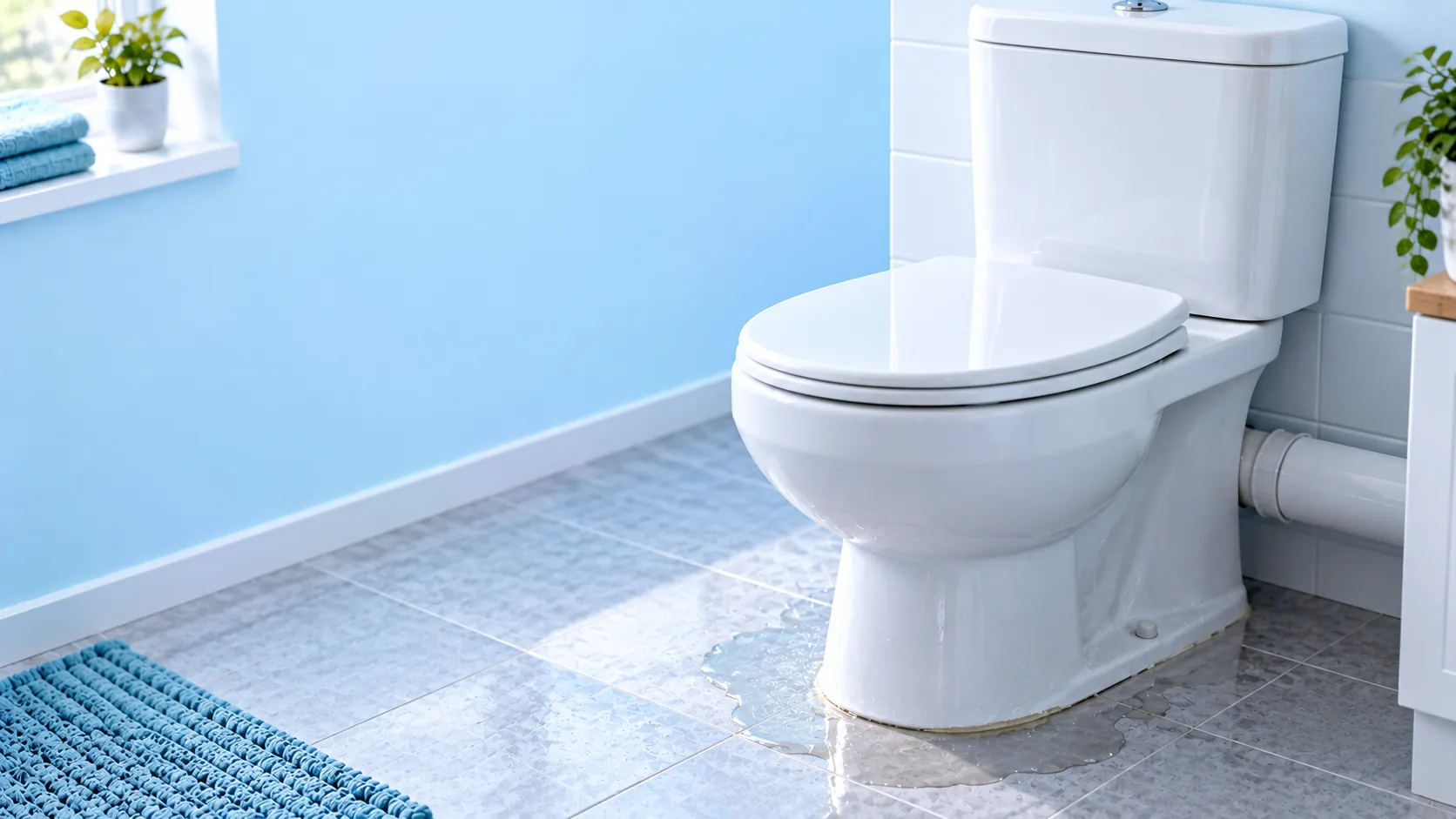
A puddle by the toilet does not prove the joint underneath has failed. Water can track down the outside of the cistern or pan, run along grout, or emerge beside the toilet from somewhere else. Look for the first point that becomes damp. Start without flushing: if the floor is already wet, adding more wastewater could make damage worse.
Choose the closest sign to see what to check first.
| Observation | Possible source | Best first action |
|---|---|---|
| Wet floor after a flush | Pan/waste connection; cistern-to-pan washer or overflow higher up | Stop using; trace the first wet joint |
| Water even when unused | Supply inlet, isolation valve, tank fittings, external condensation | Check from highest point and isolate if necessary |
| Droplets on cold porcelain | Humid air condensing on cistern or pan | Dry and observe; improve ventilation |
| Pan moves or floor feels soft | Faulty fixing, failed seal, damaged subfloor | Stop use and arrange inspection |
THE MECHANISM
Why water at the floor can start much higher up
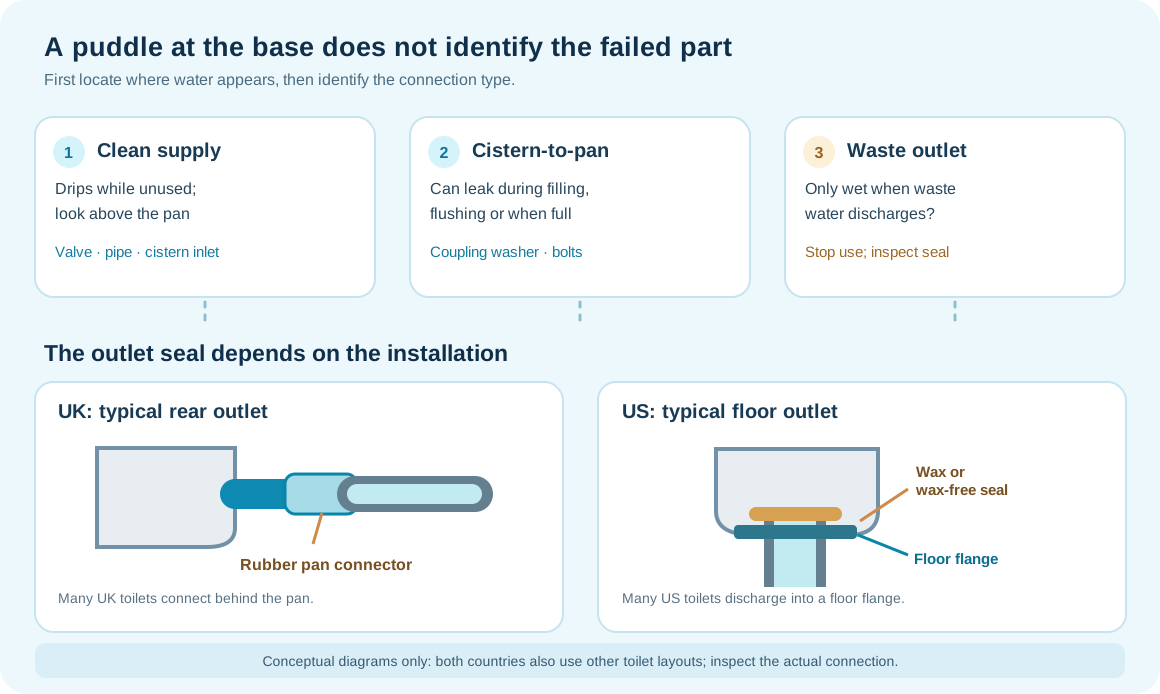
Think of the toilet as two separate water circuits. The clean-water circuit feeds the cistern through a valve and flexible or rigid supply connection. The wastewater circuit carries a flushed volume from the pan outlet to the soil pipe or floor flange. Between them, a close-coupled cistern may have a large flush-pipe/coupling seal and bolt washers.
Gravity carries escaped water down exterior porcelain until it hits the floor. A leaking supply nut can therefore create a puddle that looks identical to a waste-seal leak. Likewise, a leak from an upper cistern joint may show only when the cistern refills or during the surge of a flush, depending on which seal has failed.
Why this matters: fitting a new waste seal cannot fix a dripping inlet valve, and tightening a supply fitting cannot repair a split pan connector. A wrong diagnosis may also allow hidden floor damage to continue.
BETWEEN FLUSHES
Water appears while the toilet is not being used
Check the accessible isolation/shut-off valve, feed pipe, flexible hose, inlet connection and underside of the cistern. Place a small piece of dry tissue at each accessible external fitting and look for the highest point to turn damp. Avoid disturbing an old or corroded joint; a gentle visual check is safer than trying to tighten it while under pressure.
If the supply is dripping, turn off the toilet's local valve gently. Most screw-operated valves close clockwise, but follow your fitting's directions. If it sticks, do not force it. A shared stop tap may be needed, and persistent leakage deserves a plumber. Closing the inlet does not stop a tank of stored water or a waste seal leaking when flushed.
On a close-coupled design, cistern bolt seals and the large washer between cistern and pan can leak externally. On a US two-piece tank, the tank-to-bowl gasket and mounting bolt washers are equivalent areas to investigate. Some concealed cisterns make direct checks impossible without a suitable access panel—do not force tiled panels open.
A dripping wall or floor supply line elsewhere may also track along tile edges and surface near the toilet. If the water is present but none of the toilet fittings are wet, widen the search to the adjacent shower, basin and concealed pipework.
A COMMON FALSE ALARM
Could the water be condensation instead?
In a warm, humid bathroom, cold tap water can chill the outside of a cistern below the air's dew point. Tiny droplets form over a broad area, run down the porcelain and accumulate on the tiles. This tends to be worse during humid weather or after a steamy shower and can occur even if every joint is watertight.
After safely cleaning and drying the area, look for a uniform mist of droplets on the cistern versus a concentrated drip at a joint. Improve ventilation and reduce excess humidity. Where persistent, a plumber can advise on compatible tank insulation or other design-specific solutions. Condensation and a plumbing leak can exist together, so do not assume that all clear water is harmless.
DURING OR JUST AFTER A FLUSH
Why a toilet leaks around the base when flushed
A flush sends a short, relatively large volume of water through the toilet outlet into the drain. If that connection is displaced, compressed incorrectly, damaged or installed to a misaligned pipe, wastewater can escape briefly and then stop. Because the toilet may appear dry between flushes, the leak can go unnoticed while water enters a timber subfloor or runs below the tiles.
UK installations: a typical horizontal outlet uses a rubber-sealed pan connector joining the ceramic spigot to a soil pipe. A worn sealing lip, poorly fitted connector, excessive offset, movement or a damaged outlet can produce a flush-triggered leak. Other UK pans discharge through the floor or have concealed connectors; inspect the actual layout.
US installations: many floor-outlet toilets sit over a closet flange and a wax ring or manufacturer-specified wax-free seal. Movement, a damaged or poorly supported flange, incorrect flange height or a disturbed seal can create a similar symptom. These assemblies are not interchangeable with a typical UK push-fit pan connector.
Leaks that appear after a flush do not automatically prove a waste-seal fault. Inspect the joint between cistern and pan first, because flushing can cause water to leak externally at that higher connection. Once you suspect actual wastewater from the pan outlet, stop using the fixture until it has been repaired.
UK AND US CONNECTIONS
Pan connector, wax ring or cistern seal: what differs?
| Part | Typical layout | What goes wrong |
|---|---|---|
| Rubber pan connector | Common on UK rear-outlet toilets | Seal deteriorates, is misaligned or pulls out; leaks when flushing |
| Wax / wax-free floor seal | Common on US floor-outlet toilets | Ring displaced or flange height, fixings or support unsuitable |
| Cistern-to-pan coupling | UK close-coupled and US two-piece designs | Large washer/gasket or bolt seal leaks during filling or flushing |
| Supply valve, hose or inlet | Both countries | Pressurised clean-water drip even when toilet is unused |
| Damaged vitreous china | Either layout | Cracked pan or cistern can leak; often requires replacement |
Old installations can have cast-iron pipes, unusual bends, boxed-in connections or a toilet connected directly to the floor. Parts should be selected by actual pipe diameter, spigot dimensions, connection position and manufacturer instructions, not by the country alone. A connector installed under continuous strain may fail again even if its rubber seal is new.
STOP AND SEEK HELP WHEN NEEDED
When is a leaking toilet base urgent?
Stop using the toilet and arrange prompt assistance if you observe suspected sewage, a puddle every flush, foul odours accompanied by water, a rocking pan, a soft or swollen floor, staining on the ceiling beneath or a visible crack in the ceramic. Repeated use can extend hidden water damage even where only a small puddle appears.
If the leak is clearly from the supply side, use the local isolation valve if safely accessible; contact a plumber if it continues. If wastewater has escaped, avoid direct contact and clean up only when the source is controlled, using suitable protective precautions. Consider notifying your landlord, building manager or insurer if the premises are rented or concealed water damage has occurred.
If the toilet is upstairs and the ceiling below is wet, water may have spread far from the fixture. Keep away from wet electrical fittings and seek professional electrical advice if electrical circuits may be affected. Do not lift an unstable toilet or investigate from an unsafe ladder or through a damaged ceiling.
With a sewer backup, several slow drains or wastewater rising through other fixtures, the problem might extend beyond the toilet. See our related gurgling toilet and bubbling toilet guides to identify shared-drain warning signs.
SAFE REPAIR DECISIONS
What to check and what not to repair blindly
- Protect the floor and stop the relevant water use. Wipe up accessible standing water without touching suspected sewage; place an absorbent barrier if safe and keep others away.
- Observe the highest visible point. Look at the accessible pipework, valve, cistern underside, bolt locations and the rear waste connection. Use a torch; do not flush again if a waste leak is suspected.
- Identify the trigger. Unused toilet with fresh drips suggests clean supply or condensation; flushing-related leakage points toward joints seeing the flush surge. Neither pattern proves a single fault.
- Shut off an active supply leak. Close the accessible valve gently, without forcing it; obtain help if water continues or the fitting is unsafe.
- Arrange a matched repair. A plumber may replace a pan connector, cistern washer, supply fitting or wax/wax-free floor seal—but should also check pan support, alignment, mounting and any floor damage.
- Verify after repair. Once the correct part is installed and wastewater contact risks are controlled, check both stationary and flush conditions while inspecting accessible joints and the area below.
One-piece and concealed installations may require specialist removal; lifting a toilet is heavy and risks cracking the china, straining rigid pipes and exposing wastewater. If a floor seal has failed, the replacement choice also depends on flange height and the finished-floor level. For US floor-outlet toilets, Kohler's installation instructions specifically warn against rocking a toilet after seating it on a wax ring and against overtightening studs.
QUICK ANSWERS
Frequently asked questions
Why is my toilet leaking at the base only after flushing?
The flush may be sending water past a damaged waste joint, UK pan connector or US floor seal. However, a close-coupled cistern washer can also leak when flushed. Stop using a toilet that leaks wastewater and trace the first wet location before ordering parts.
Can a loose toilet cause a leak?
Yes. Movement can stress a connector or disturb a floor seal. But a rocking toilet may also have broken fixings or weakened flooring; simply tightening harder can crack ceramic without correcting the underlying problem.
Is a wax ring used on UK toilets?
Many UK toilets instead connect to a soil pipe using a rubber-sealed pan connector. Other designs exist, including floor outlets. Check the actual outlet arrangement and the manufacturer instructions before choosing a part.
What if water appears even when I have not flushed?
Inspect the accessible supply pipe, stop valve, cistern inlet and bolt joints for external drips, and check for condensation. A puddle at the base can be fed from a higher connection.
Can condensation cause water around the base?
Yes. Moist bathroom air can form droplets on a cold cistern that run down to the tiles. Widespread droplets and a humidity link point toward condensation, but do not exclude a simultaneous plumbing leak.
Does a clear puddle mean it is safe water?
No. Water from a toilet waste joint may still look clear. Treat suspected discharge leaks as potentially contaminated and avoid contact.
Can I use silicone to stop the leak?
No. Silicone on the floor line does not repair a defective connector, wax seal or pressurised fitting. It can hide water damage and make the real source harder to locate.
Can I still use the toilet if the floor is only slightly damp?
If the dampness follows a flush or wastewater is possible, stop using it until the source is found and repaired. Continued use can damage hidden flooring. If you have established condensation only, address bathroom humidity and monitor.
Will I need a new toilet?
Not necessarily. Many leaks come from replaceable valves, rubber joints, cistern washers or flange seals. A cracked pan, unsafe fixings or irreparable installation damage may require replacement or more extensive work.
How do I know if the leak damaged the floor below?
Watch for swelling, soft tiles, staining, musty odour and marks on the ceiling beneath. Even a dry surface can hide moisture; a plumber or leak specialist may need to assess the subfloor.
MANUFACTURER AND WATER-UTILITY REFERENCES
Technical sources and further reading
These references support water-isolation precautions, wax-ring handling and why different leak pathways need different repairs. They cannot establish which component has failed on your particular toilet.
- WaterSafe — what to do when you find a leak
- Thames Water — find and operate an isolation valve
- Kohler — installing a wax ring on a suitable toilet
- Fluidmaster — wax-free floor-seal installation and flange-height guidance (PDF)
- Thames Water — arranging leak repair
Start again with the Toilet Problems hub or browse the Plumbing Problems hub.
Related guides: a toilet that keeps running · a weak toilet flush · toilet gurgling · low toilet water